
AI Is Making Bad Management Look Productive
AI productivity is increasing production capacity. The harder management problem is deciding what deserves attention, what deserves action, and who owns the outcome


Photo by Dmytro Tolokonov on Unsplash
Imagine a manager who used to get five proposals a month. Now AI produces fifty.
Imagine a marketing team that used to develop two campaign concepts a quarter. Now AI produces twenty in an afternoon.
Imagine a research team that used to spend a week building a report. Now three versions show up before lunch.
Everyone looks more productive.
Someone still has to decide what matters.
AI productivity refers to the gains an organization gets when AI helps people finish work faster, handle more tasks, or produce more output. Those gains matter. They don’t tell the whole story. An organization also needs to work out what deserves attention, which decisions follow, and what outcomes result.
AI productivity is incomplete when you measure it only by output. AI increases production capacity faster than many organizations increase their ability to select, decide, and evaluate results.
The productivity gains are real
Start with the true part. A field study of 5,172 customer-support agents at a Fortune 500 software company found a 15 percent increase in issues resolved per hour after workers got access to a generative AI assistant, published in a Quarterly Journal of Economics study.
AI Generated
The gains weren’t even across the workforce. Less experienced and lower-skilled agents improved in both speed and quality. The most experienced and highest-skilled agents saw small gains in speed and small declines in quality.
That second finding matters as much as the headline number. Speed and quality don’t move together automatically. Experience changes what AI assistance does for a worker. In this study, the human agent stayed responsible for the conversation. AI supplied suggestions. Workers accepted them, edited them, or ignored them.
The answer isn’t to pretend these gains don’t exist. They do. The real question is what happens after they increase the amount of work an organization produces.
Hold onto that detail. It’s the seed of the argument.
The interesting question begins after the productivity number.
If AI is genuinely making people faster, why doesn’t your organization feel more productive? AI productivity often feels disappointing when production grows faster than an organization’s capacity to select what matters. Your team generates more work, but managers still need to evaluate it, prioritize it, decide, and own the results. The organization gets more output without necessarily getting better outcomes.
Why AI productivity creates a selection problem
AI now generates more reports, more recommendations, more proposals, more campaign concepts, more dashboards, more drafts, more options. Production, the thing organizations used to struggle to generate enough of, is getting cheap.
Someone still has to decide which of those outputs deserve attention.
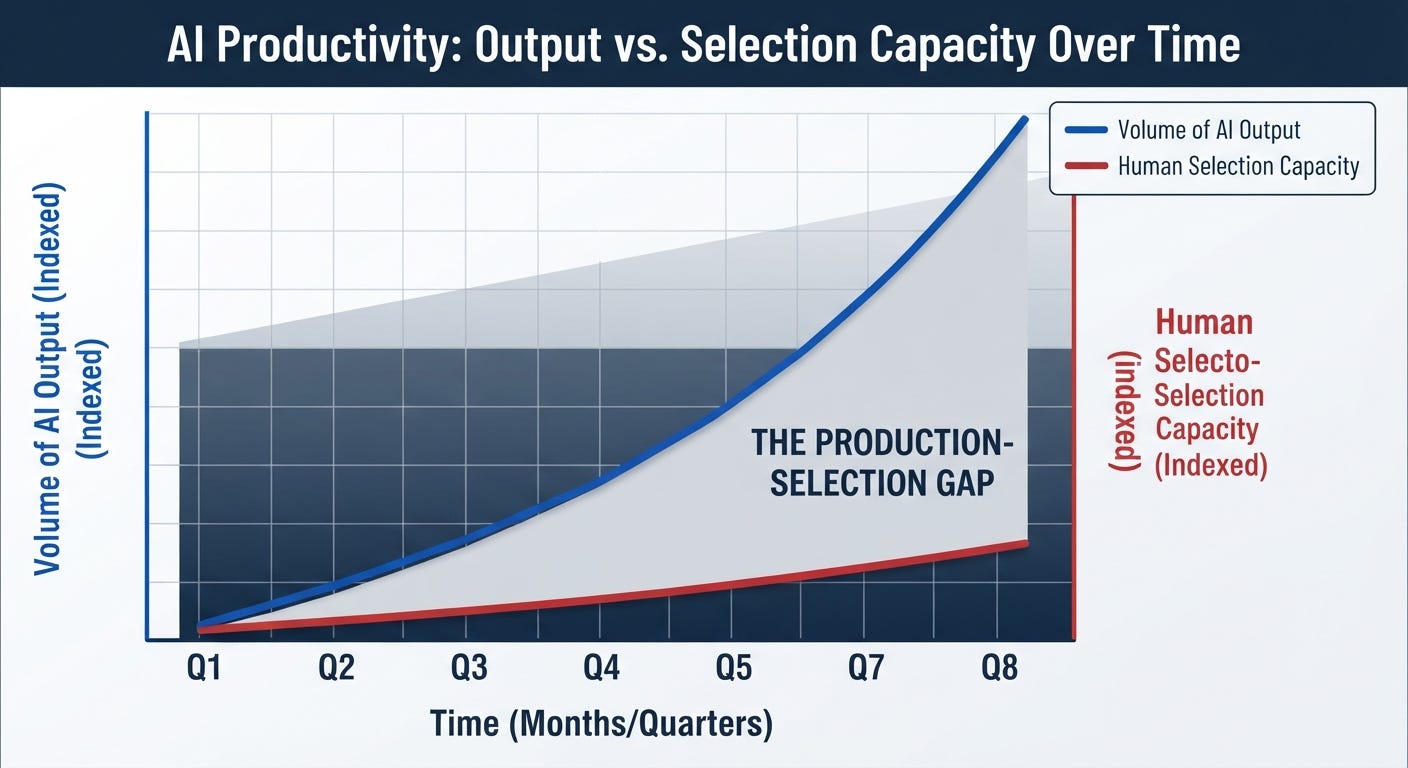
The Production-Selection Gap describes what happens when AI increases production faster than an organization increases its ability to evaluate and prioritize the resulting work. The larger the gap grows, the more managers spend their time filtering, ranking, rejecting, and deciding instead of producing.
Selection capacity is the organizational capability this exposes: an organization’s ability to evaluate, prioritize, reject, and act on a growing volume of AI-assisted output. When production grows faster than selection capacity, work piles up between generation and decision. Most teams never built this capability because they never needed it. Nobody had to develop a discipline for triaging fifty proposals when there were only five.
AI solved your production problem. It made your selection problem bigger.
AI is making bad management look productive
This is where it gets uncomfortable.
More proposals substitute for strategic clarity. More dashboards substitute for an actual decision. More reports substitute for prioritization. More experiments substitute for a theory of change. More content substitutes for understanding your audience.
None of this is AI’s fault. AI didn’t create indecisive management, unclear priorities, or leaders who avoid hard calls. AI increases the volume of activity available to point to instead.
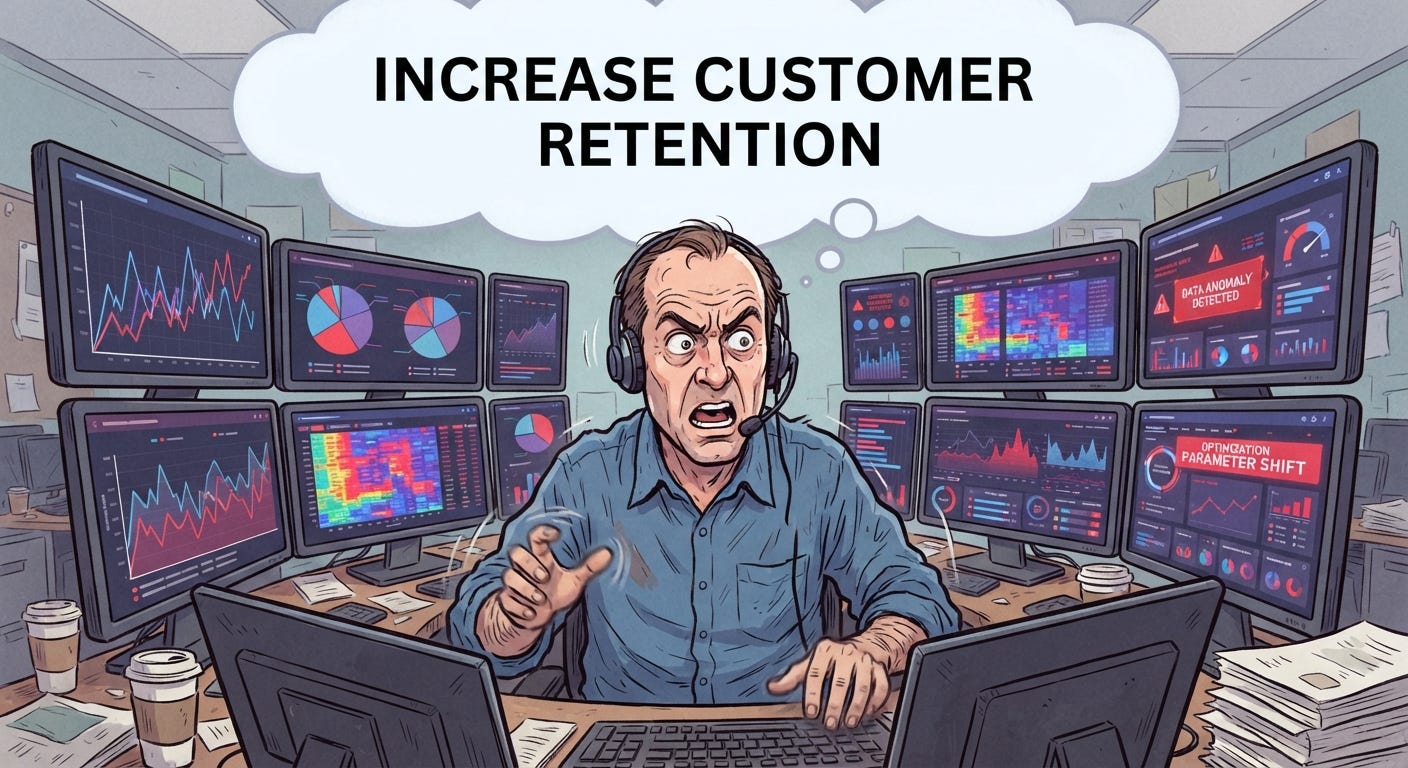
AI makes indecision look like thoroughness.
A team producing constant AI-generated output looks busy. Looking busy has always been easier to measure than being effective. AI made looking busy dramatically cheaper to produce. It made looking busy dramatically easier to hide behind.
AI Generated
Meanwhile, the manager’s job changed shape without anyone announcing it. AI does more of the drafting. The manager does more of the reviewing. Fifty proposals still need a reader. Twenty campaign concepts still need someone to pick the two worth funding. The manager who used to spend a week writing now spends a week filtering, and filtering fifty options well takes real judgment, not only time.
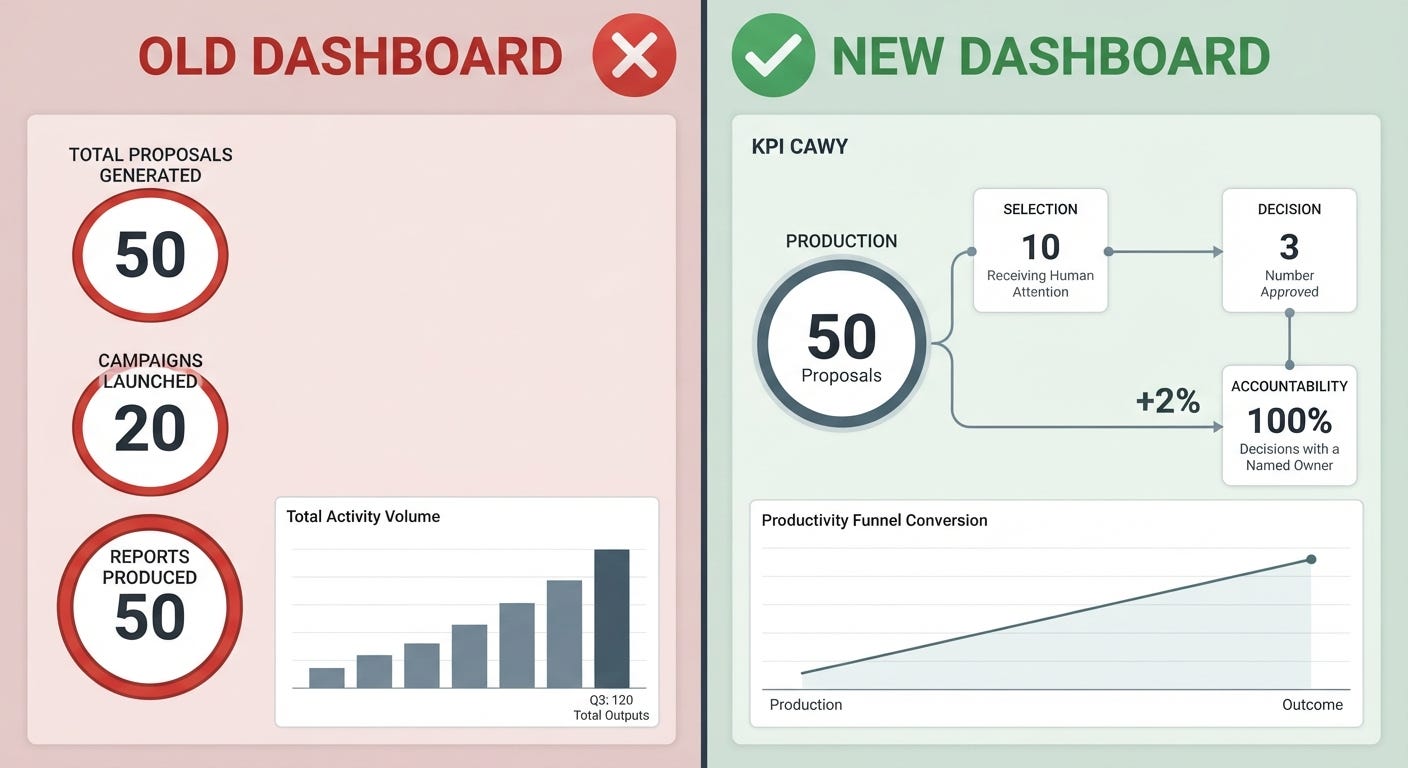
The Production-to-Outcome Model
Here’s a simpler way to see the whole chain.
Production. What gets generated?
Selection. What receives attention?
Decision. What gets approved, rejected, funded, published, implemented, or ignored?
Outcome. What changes because of the decision?
Most organizations measure the first stage and stop. Output becomes the proxy for productivity because output is the easiest number to count. It sits right there in the dashboard. Decisions and outcomes take longer to show up, and they’re harder to attribute.
Output tells you how much work exists. Productivity asks what work is accomplished.
Production measures activity. Outcomes measure consequences. Selection reveals judgment. Decision reveals who holds authority. Governance, the system underneath all of it, reveals whether anyone is accountable for what happens next.
Why doesn’t more AI output automatically mean more productivity? Because output measures production, while productivity depends on what the organization selects, decides, and accomplishes. AI increases the first. Management and governance determine what happens next.
Why does this matter? AI changes the location of the productivity problem. When production is scarce, organizations focus on producing enough work. When production becomes abundant, organizations need better systems for selecting, deciding, and acting. AI productivity increases production. Production creates selection demand. Selection requires judgment. Judgment informs decisions. Decisions require authority. Authority requires governance. Governance establishes accountability. Accountability connects decisions to outcomes.
AI governance is part of the productivity problem
NIST’s AI Risk Management Framework argues that human roles and responsibilities in AI-assisted decision-making need clear definition and differentiation, and that different human-AI configurations, from fully autonomous systems to AI that simply informs a human decision-maker, call for different oversight. Governance, in this framing, isn’t paperwork bolted onto a project after it ships. It’s the structure determining who gets to act on what AI produces.
In this context, AI governance means defining who has authority over AI-assisted work, where human review applies, when a decision requires escalation, and who remains accountable for the result. Governance determines how AI-generated production becomes accountable action.
The OECD AI Principles likewise call for human agency and oversight, transparency, and accountability in trustworthy AI.
AI generates the recommendation. Governance determines who gets to say yes.
Practically, this means answering a short list of questions before volume becomes a problem instead of after. Who approves? Who rejects? Who overrides the system? When does something get escalated instead of decided at the point of contact? Who owns the result once it ships?
The question isn’t whether AI or a human generated the recommendation. The question is who had the authority to act on it.
Skip this step and volume becomes the whole story. Fifty proposals arrive, nobody owns the choice between them, and the organization defaults to whichever one made it into the right meeting. That’s not selection. That’s chance, given a process to hide inside.
What should companies measure instead of AI output?
Companies should measure AI productivity beyond production by examining selection, decisions, outcomes, rework, escalation, and accountability. None of what follows is an established industry standard. Treat it as a starting proposal, something to argue with and adjust for your own organization.
Production: how much work did AI help generate?
Selection: how much of that work got meaningful human attention?
Decision: how many outputs produced a decision, versus sitting in a queue?
Outcome: what changed in the business because of those decisions?
Rework: how much AI-assisted output needed significant correction?
Escalation: how often did uncertainty or risk force the work up to a human?
Accountability: does every consequential AI-assisted decision have a named owner?
Production, Selection, Decision, and Outcome trace the model. Rework and Escalation tell you where the process breaks. Accountability tells you who owns the consequence.
A team that scores high on production and low on everything else isn’t productive. It’s busy.
The management test
Five questions, worth running against your own team this week:
Are you measuring output or outcomes?
Are you producing more work than your managers have time to evaluate?
Who decides which AI outputs matter?
Where does human review enter the workflow, and where is it a formality?
Who owns the consequences when a decision goes wrong?
But isn’t more output still more productivity?
Yes. The QJE study is real evidence of real gains in a real workplace. This isn’t an argument against AI, and it isn’t an argument that productivity numbers are fake.
Production is necessary. It’s the input the rest of this chain depends on.
It’s also not sufficient. A company producing more without deciding better, selecting better, or owning outcomes better ends up with a bigger pile of work and the same organizational results it started with.
What AI productivity leaves out
This is part of a larger shift I’ve been calling the Judgment Economy, where the scarce resource moves from producing work toward deciding what deserves attention. When production was expensive, producing enough work was the constraint. AI made production cheap. The constraint moved downstream, first to selection, then to decision quality, then to who holds the authority to decide, then to who answers for what happens after.
The manager in the opening example still has fifty proposals. What changed is the scarce resource. It used to be proposals. Now it’s attention. The team that wins isn’t the one producing the most. It’s the one that gets faster at deciding what to do with what it produces.
When your organization says AI made the team more productive, what exactly is being measured? How much work was produced? How much was rejected? How much better were the decisions? What changed because of them?
If nobody knows the last two answers, the organization is measuring production, not productivity.
AI Generated
Thanks for Reading
Buy Me A Coffee |Gumroad| Medium
Gregory H. Bourne is a writer, author, and AI strategist examining artificial intelligence through the lenses of governance, business, culture, and human judgment. The AI Socialist explores what happens when technology changes not only how we work, but who makes decisions, who holds power, and who remains accountable.