
Are Nations Becoming Airports?
What Happens When Nobody Stays Put Anymore? Mobility, Belonging, and the New Meaning of Home

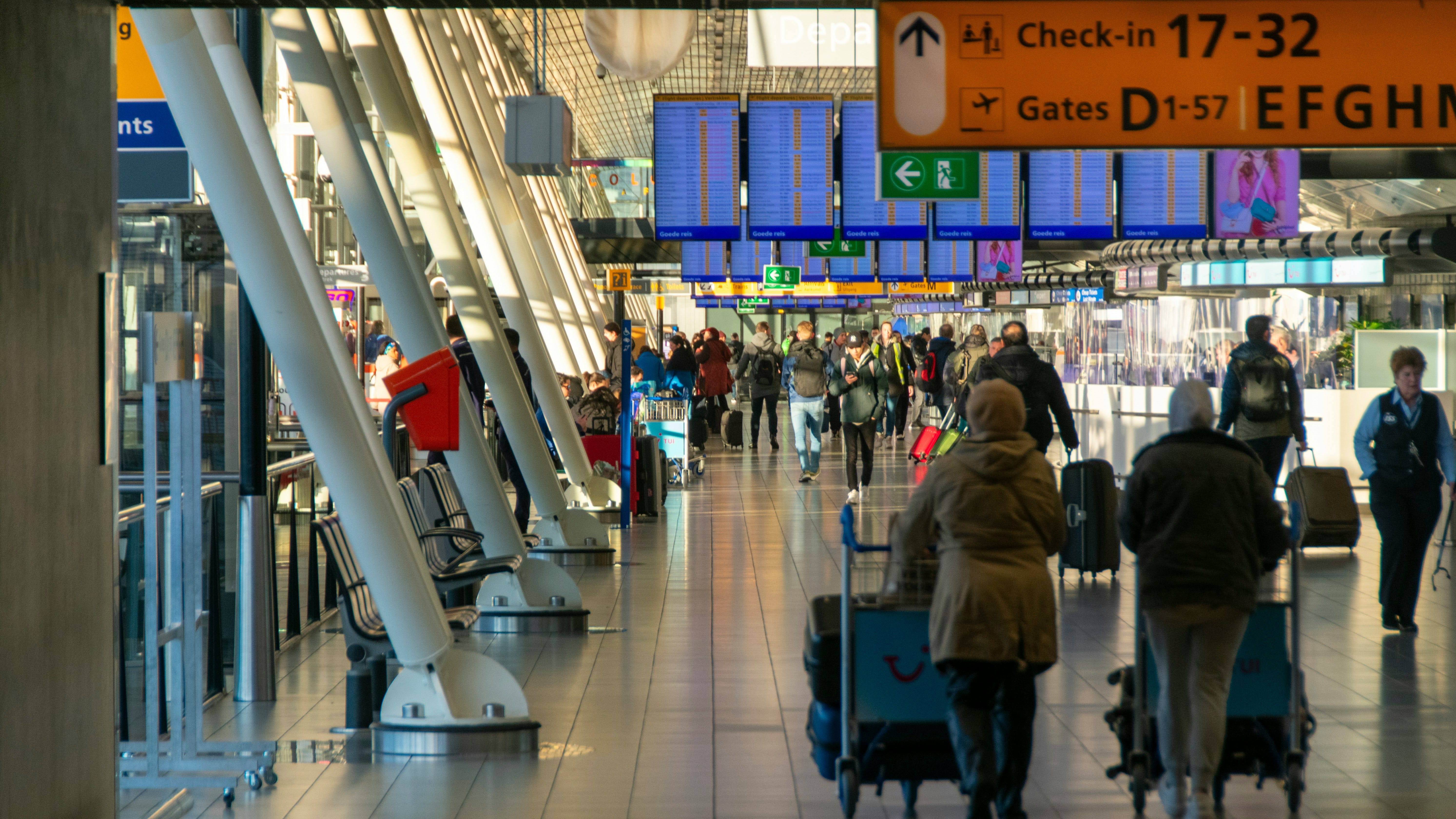
Photo by Pim de Boer on Unsplash
Episode #113
What Happens When Nobody Stays Put Anymore?
Most debates about migration focus on who is arriving and who is leaving.
Look at almost any chart on the subject and the framing is the same: inflows, outflows, net change. A country either gaining people or losing them.
That framing misses the more interesting shift happening underneath the numbers.
Mobility itself is becoming normal. Not for refugees. Not for a small elite of executives and diplomats. For ordinary people - knowledge workers, retirees, young families - who increasingly treat borders the way previous generations treated city limits. Something you cross when the situation calls for it, not something that defines you.
As work, family, and identity move across borders, nations increasingly function less like destinations and more like platforms people pass through, return to, and remix. The airport has become the perfect metaphor for modern belonging - a borderless lobby where mobility, not geography, is the organizing principle.
This is a piece about mobility and belonging. About what happens to identity, culture, and the idea of "home" when staying put stops being the default.
The Core Question
What happens to culture when mobility becomes normal?
Not migration in the political sense - the policy fights, the border debates, the headlines. Something quieter and more structural. What happens to the meaning of a nation when increasing numbers of its people treat it less like a permanent address and more like a node in a larger network?
That's the question this essay sits inside. Before we go further, look at the picture underneath it.
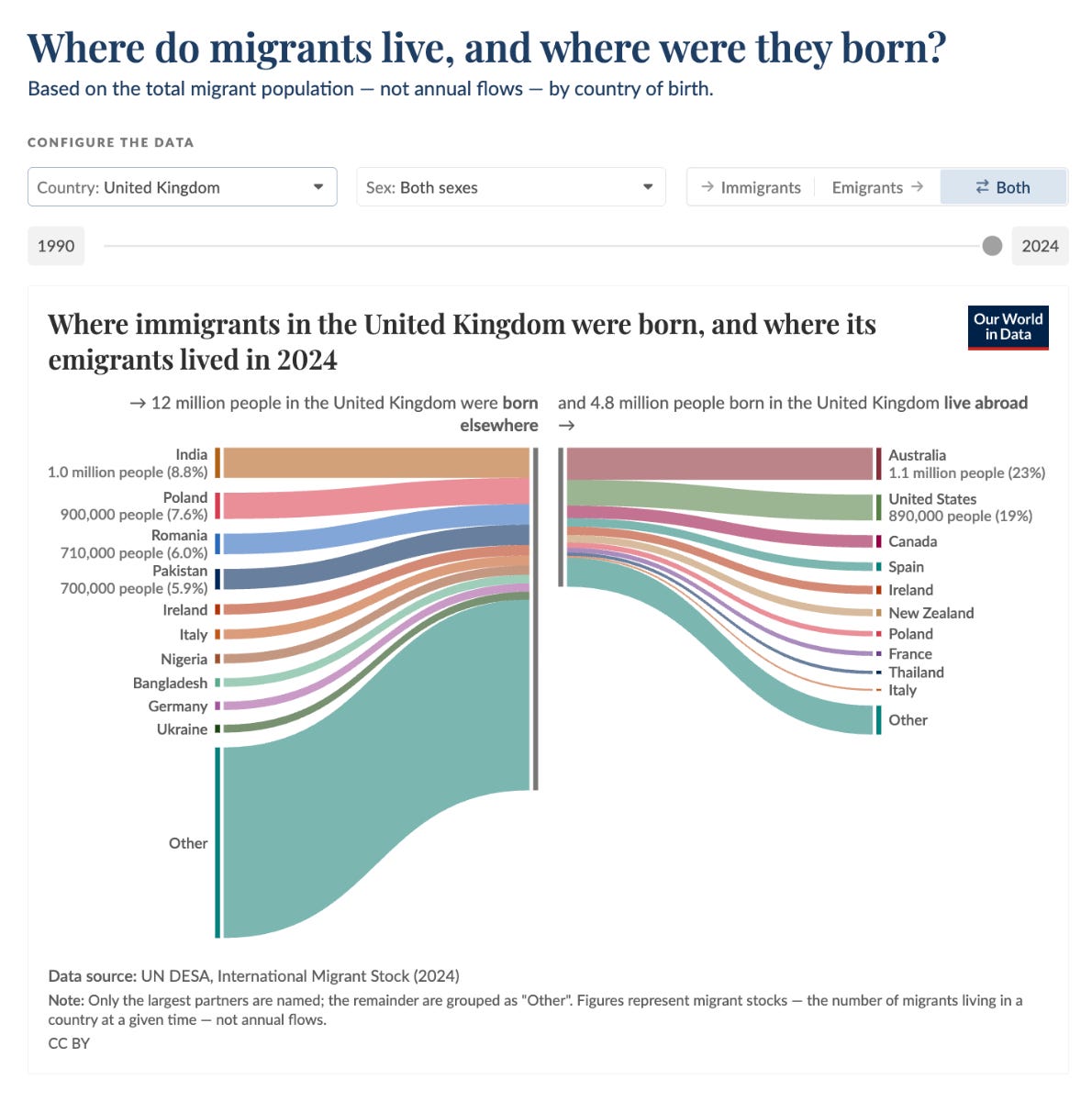
The graphic shows millions of people who currently live in the United Kingdom but were born somewhere else, and millions of people born in the United Kingdom who now live somewhere else. At first glance, it looks like a migration story. Look closer. It may actually be a story about something bigger - a world where fewer people stay put, where movement is becoming the norm, where nations increasingly resemble airports: places people pass through rather than places they stay.
The Airport as the New Borderless Lobby
Airports used to be infrastructure. A means to an end. You went through one to get somewhere else, and nobody thought much about the building itself.
That's changed.
Airports are now cultural environments in their own right - spaces where nationality, history, and mobility intersect, and where, increasingly, we can see how people belong, and how they don't. Research on the cultural influence of airport design has described major contemporary airports as effectively becoming "nation-states" in their own right - vast, self-contained cities built around the processing of passengers rather than the traditions of the places they sit in. The same research traces how airports function as a kind of gateway architecture, where countries deliberately use design and cultural reference points to declare an identity to arriving and departing travelers.
But airports reveal something else too, something less designed and more lived-in.
For some displaced travelers, migrants, and globally mobile people, airports become the only place where they can build a version of home - even as the experience of being there underscores a loss of community anchors and a familiar sense of place. Scholarship on what's been termed [homesickness in the context of global mobility](https://academicworks.cuny.edu/ny_pubs/549/) has examined this directly through real accounts of displaced travelers, showing how the anxieties of constant movement intensify precisely because people lose the social orientation points that used to come from staying put.
That's the tension worth sitting with. The airport connects people to the world. It also reminds them, every time, that they are between worlds. Neither here nor there. Mid-transition, permanently.
Here's the aha moment hiding in that research: the airport isn't the opposite of home.
For a growing number of people, it has become the closest thing to one.
## Section 2: Remote Work Made Mobility Ordinary
For most of modern history, international mobility belonged to a narrow slice of the population. Executives relocated for the company. Diplomats were posted abroad. Migrants moved out of necessity, often at real cost and real risk.
Everyone else stayed where their job was. Because the job was the anchor.
Remote work mobility broke that link. Once a meaningful share of jobs no longer required a specific desk in a specific building, location stopped being a precondition for employment and became something closer to a preference.
This is worth pausing on, because the popular story about remote work has always been about productivity. That's the wrong headline.
The most significant effect of remote work may not be productivity at all. It may be mobility.
Governments noticed. [OECD migration policy](https://www.oecd.org/en/publications/should-oecd-countries-develop-new-digital-nomad-visas_4d425e15-en.html) research tracks how the first formal "digital nomad visa" schemes appeared across OECD countries starting in 2020, with special legal status for remote workers continuing to spread since. These programs all share the same basic shape: they court location-independent workers who bring foreign income without needing a local job offer. As of the OECD's most recent migration outlook, the list keeps growing - Italy, Türkiye, and Bulgaria have all rolled out new schemes in the past two years, while countries like Croatia have extended how long nomads are allowed to stay.
Researchers studying the institutional side of this shift have examined how governments are actually building visa systems for digital nomads, reviewing nomad-specific visa policy implemented worldwide. Academic work proposing a three-level framework for understanding digital nomadism within migration studies goes further, arguing that digital nomads are a genuinely new category - transnational remote workers who challenge nation-state-centered ideas of employment, taxation, and citizenship, made possible largely because they hold the kind of citizenship and passport strength that allows this freedom of movement in the first place.
That's the deeper point. Governments are still organized around territory - tax residency, healthcare systems, voting districts, all built on the assumption that people live somewhere in particular. Workers, meanwhile, are increasingly organizing their lives around flexibility, treating location as a variable rather than a constant.
Remote work didn't just change where people work.
It changed what a location means.
Global Citizens, Local Frictions
Once movement becomes easy and frequent, identity starts to follow a different logic.
A growing number of people now describe themselves in terms of global networks - professional, digital, diasporic - as much as, or more than, they describe themselves by a single nationality. This is sometimes framed as global citizenship, a concept built on the idea that a person's identity can transcend, while still respecting, geographical and national borders.
The data backs up how fast this sentiment has been moving. A large-scale international poll conducted for the BBC World Service found that, for the first time since tracking began in 2001, a majority of people across the countries surveyed identified more as global citizens than as citizens of their own country - 51% in 2016, up sharply in large emerging economies like Nigeria, China, Peru, and India. The shift was less pronounced in wealthier, more established economies, revealing a real divide in who's most likely to feel unmoored from a single national identity.
This creates real opportunities: access to ideas, markets, and relationships that simply didn't exist for people whose worlds ended at the edge of their hometown.
It also creates real tension. Can someone belong everywhere? Can someone belong nowhere? What happens to a society when a global identity becomes more comfortable than a national one - at least for the people with the means to choose it?
The modern global citizen often has more options than previous generations ever had.
But fewer anchors. More doors. Fewer load-bearing walls.
Third-Culture Adults and the Meaning of Home
This is where the question stops being abstract.
What does home mean when your parents were born somewhere else, you grew up somewhere else again, and your own children may end up living somewhere different still?
This isn't a hypothetical for a shrinking number of people. It's the lived experience of an expanding group sometimes called third-culture adults - people who grew up, often as children, outside their parents' culture and never fully belonged to any single one. One [first-person account of life as a third-culture adult](https://www.inspirethemind.org/post/where-is-home-for-third-culture-adults) describes feeling closest to other cross-cultural people: international students, the children of immigrants, anyone who heard a different language at home - and finding that home isn't a single location so much as a recurring feeling, conjured by a smell, a food, a familiar gesture, no matter where in the world it happens.
Academic research on [adult third-culture kids and how they discursively negotiate belonging](https://www.sciencedirect.com/science/article/abs/pii/S0147176723000925) backs this up with more structure. The research describes belonging for this group as a genuinely multilevel phenomenon - operating at an intrapersonal level (through memory, nostalgia, and a sense of being "in-between"), an interactional level (through relationships and social context), and an institutional level (through history, politics, and legal status). Crucially, the same research found that for adult third-culture kids, home discursively traverses several loci and levels of meaning-making - it isn't tied to one nation, but distributed across many.
For third-culture adults, home isn't a location. It's layered. Relational. Portable. And sometimes fragile - built less out of geography and more out of the people who happen to be in the room.
The tension is real, and it doesn't resolve neatly. People can carry multiple identities, multiple homes, multiple cultural fluencies - and still feel rootless. Carrying more doesn't automatically mean feeling more grounded.
Home may no longer be a location.
It may be a collection of relationships.
When Belonging Becomes Portable
Pull the threads together, and a pattern emerges.
When work moves, family moves, and identity moves, belonging itself starts to change shape. Nations become less like permanent destinations people are born into and die in. More like platforms people pass through, return to, and remix over a lifetime.
People increasingly move through countries the way previous generations moved between cities - Toronto to Vancouver, instead of Canada to Australia, with roughly the same emotional weight attached to the decision.
That's mobility's promise: freedom of movement, freedom of identity, freedom from the accident of where you happened to be born.
It's also the cost of mobility. The same freedom that lets people opt out of geography also makes community harder to build and easier to leave. Local institutions depend on people staying long enough to invest in them. Mobility, by definition, makes staying optional.
The question used to be: Where are you from?
The question now is: Where do you belong?
And increasingly, those are no longer the same question.
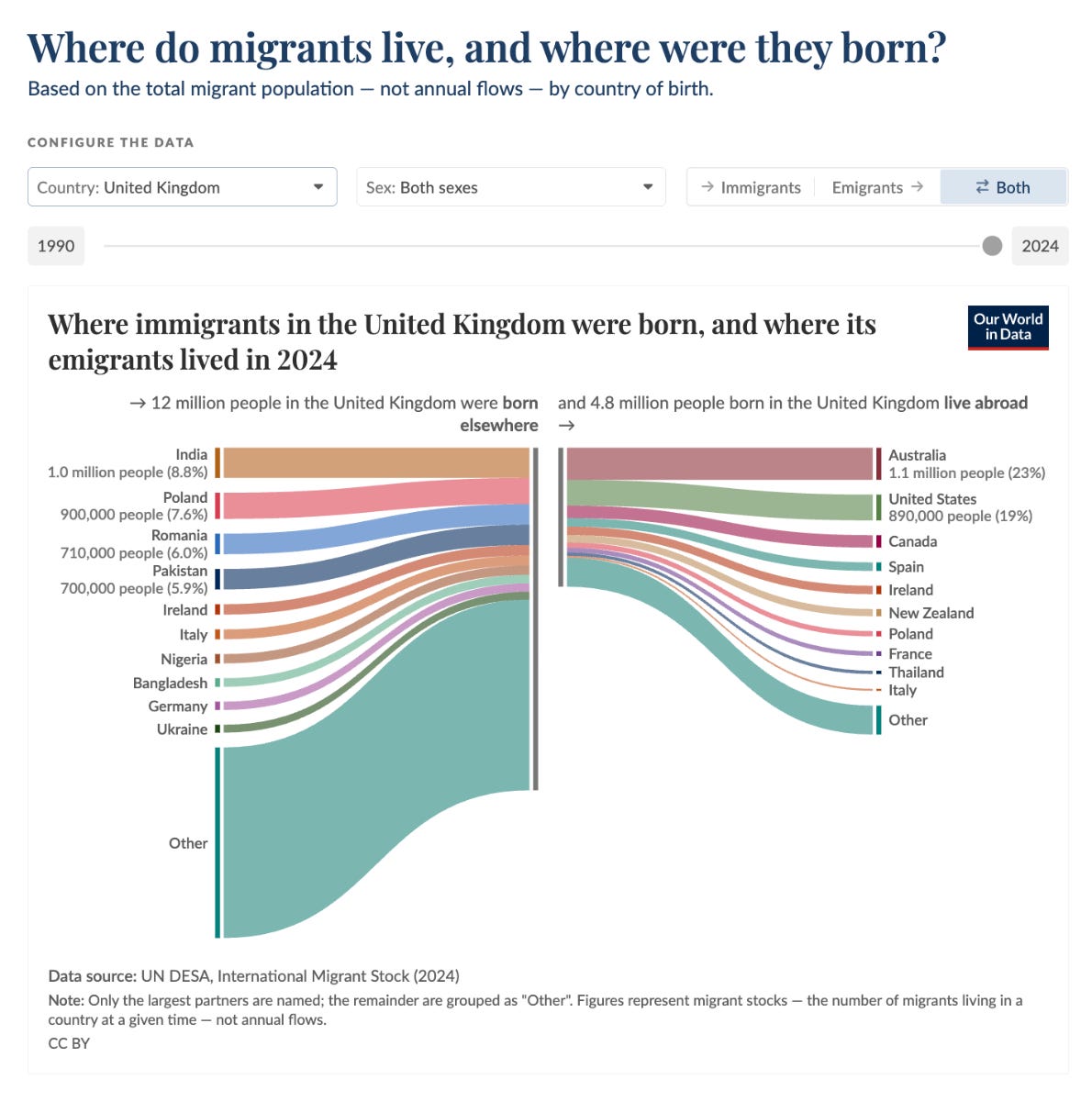
Look at the chart again.
Millions of people were born somewhere other than where they now live. Millions more who were born in one country and now live in another, scattered across a dozen destinations, each line on that chart a household, a career decision, a relationship, a kid enrolled in a new school.
The chart isn't simply showing migration.
It's visualizing a broader cultural transition - a shift from permanence to movement, from rooted identities to layered identities, from fixed homes to portable belonging.
When mobility is no longer exceptional, "home" is no longer a single place. It's a network of relationships, memories, and bookings - and the airport is where that network becomes visible.
---
### Sources
- Brierley, A. ["Research: Cultural Influence on Airport Design."](https://www.scottbrownrigg.com/design-research-unit/articles-publications/research-cultural-influence-on-airport-design/) Scott Brownrigg, Design Research Unit.
- Scanlan, S. (2019). ["Global and Radical Homesickness: Rewriting Identities in the Airport Narratives of Pico Iyer and Sir Alfred Mehran."](https://academicworks.cuny.edu/ny_pubs/549/) *Modern Language Studies*, via CUNY Academic Works.
- OECD (2022). ["Should OECD Countries Develop New Digital Nomad Visas?"](https://www.oecd.org/en/publications/should-oecd-countries-develop-new-digital-nomad-visas_4d425e15-en.html) Migration Policy Debates, No. 27.
- Bednorz, J. (2024). ["Working from Anywhere? Work from Here! Approaches to Attract
Thanks for Reading
Buy Me A Coffee |Gumroad| Medium
Gregory H. Bourne Writes at the intersection of analog life and digital power, crafting frameworks for people who weren’t supposed to be part of the tech conversation. A published author and AI consultant, he helps Black solopreneurs and midlife founders build robust digital systems without compromising human judgment.