
Arrest First, Figure Out the Law Later
The Don Lemon case shows how enforcement works when the goal isn't conviction but control

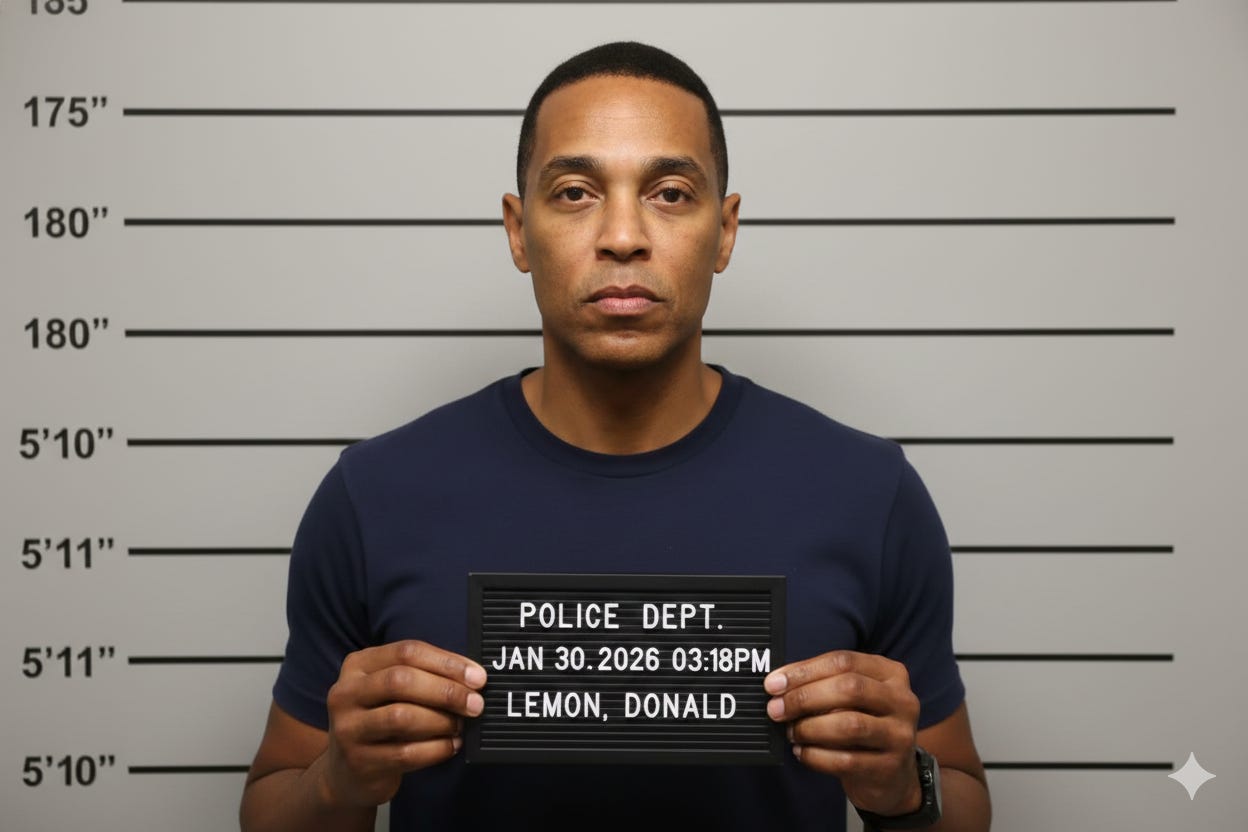
AI-Generated Image
Emergency Pod!
The Don Lemon arrest scrolled past as breaking news does. His face in handcuffs. A church protest in Minnesota. The framing wrote itself: celebrity journalist, controversial situation, legal trouble.
That’s where most people stopped paying attention.
The story wasn’t about one person.
Multiple journalists were arrested at the same protest. Different times. Different locations around the event. All of them claimed they were documenting, not participating. The pattern was there if anyone bothered to look.
Here’s where it gets interesting.
A magistrate judge questioned the probable cause. Charges weren’t clear when the arrests happened. Prosecutors hesitated, then revised their approach. The legal foundation was shaky from the start. But the arrests went forward anyway.
Notice the timing.
Arrests happened before anyone ruled on whether they were justified. No immediate clarification on journalist protections. No legal guidance. Detention, warrants, and booking processes all rolled forward while the legal questions sat unanswered.
The arrests did their job regardless.
This is where people miss the point. They wait for convictions. They wait for verdicts. They think the outcome is what matters. But the arrest itself is the outcome. The legal resolution is almost beside the point.
Think about what happens to a journalist after an arrest. Even if charges get dropped. Even if a judge says the arrest was wrong. Even if the entire case falls apart.
Time gets lost. Money gets spent. Reputation takes hits. Future coverage decisions get recalculated. Risk assessment changes. The next protest, the next story, the next moment worth documenting becomes a decision with new weight attached to it.
Behavior shifts without a single conviction.
This is governance by uncertainty. Clear rulings would set boundaries. Everyone would know where the line is. But ambiguity does something better for those with enforcement power. It makes people hesitate. Fear works faster than prohibition. Hesitation spreads wider than any legal precedent.
The church setting adds another layer.
Protection of worship. Moral legitimacy is attached to religious spaces. Public perception forms before any legal review happens. The framing does work that no legal argument has to touch. People hear “church protest” and intuitions kick in before facts get sorted.
Who pays for this?
Institutional journalists have legal teams. Independent journalists have credit cards and stress. The further you get from institutional backing, the riskier the documentation becomes. Legal costs accumulate. Time disappears. Exposure to arrest becomes a professional calculation, not a civic given.
Journalism becomes a different profession depending on your resources.
Here’s what precedent looks like without a ruling.
Behavior changes before judges weigh in. Arrests teach lessons without verdicts. Coverage decisions shift in real time. Power moves faster than law. The deterrent effect happens immediately. The legal clarity arrives later, if at all.
People are already adjusting their actions based on arrests that might not hold up in court.
This is efficient. This is strategic. This is how enforcement works when the goal isn’t punishment but behavioral modification.
Coverage doesn’t happen. Stories go undocumented. Silence gets produced through uncertainty rather than explicit prohibition. Nobody has to ban journalists from protest sites. You just arrest enough of them under ambiguous circumstances and let the profession do its own risk management.
The outcome doesn’t require a verdict.
The outcome is already here. It’s the coverage you’re not seeing. The documentation that doesn’t exist. The questions that don’t get asked because the person who would have asked them is recalculating whether the story is worth the legal exposure.
Legal ambiguity isn’t a bug in this system.
It’s the entire operating principle.