
Climate Change Isn't Failing Because We Lack Solutions. It's Failing Because Power Is Concentrated
Climate change is more than an environmental problem. Research shows wealth concentration, political influence, and carbon inequality slow climate action even as clean technology advances

Most conversations about climate change focus on electric cars, recycling, or solar panels. Those matters. Yet one question gets far less airtime. If the science has been settled for decades, why has progress moved so slowly?
The usual answers point to politics, or human nature, or the sheer difficulty of moving an industrial civilization off fossil fuels. All partly true. But there is a quieter explanation hiding underneath the loud one, and it has less to do with belief and more to do with who benefits from the current arrangement.
Climate change is an environmental crisis. It is also a political economy problem. And once you see the second part, the first part starts to make a different kind of sense.
Five Ideas to Keep in Mind
• Climate change is an environmental crisis and a political economy problem.
• Wealth concentration drives a disproportionate share of global emissions.
• Political influence often slows or weakens climate policy.
• Climate skepticism extends beyond science into debates over regulation and economic priorities.
• The people who contribute least to emissions often face the greatest climate risk.
Climate Change Is Also a Political Economy Problem
Political economy asks who holds power, who benefits from how that power gets used, and who pays the cost. Applied to climate, the question becomes simple: emissions have fallen in some places even as clean technology has advanced everywhere, so why hasn’t the overall trajectory bent faster? Part of the answer is concentrated wealth and influence.
Solar power is now the cheapest form of new electricity generation in most of the world. Battery costs have collapsed. Electric vehicles have transitioned from novelty to the norm. By any measure of engineering progress, the tools exist.
And yet, global emissions continued to climb for most of the last three decades, slowing only recently and unevenly. That gap between what technology makes possible and what actually happens is the tell. It suggests the obstacle was never primarily technical.
This is where political economy earns its keep. It is the study of how economic systems and political power shape each other, and it forces a specific question onto the table: who benefits from the pace of change, and who gets to set that pace?
A useful distinction sits at the center of this. Markets generate wealth. Oligarchies concentrate influence. Those are not the same phenomenon, and confusing them is where a lot of climate arguments go sideways.
Capitalism Isn’t the Same Thing as Oligarchy
Competitive capitalism and oligarchic capitalism produce very different climate outcomes, even though they share a name. Competitive markets reward entrepreneurship and let new firms challenge incumbents. Oligarchic systems protect incumbents through concentrated ownership, regulatory capture, and control over the information environment. The distinction matters because critiquing concentrated power is not the same as critiquing markets.
To see why the system is stalling, we must visualize the structural difference between how markets are supposed to work and how they actually function under concentrated power.
Now, picture a market where five companies control most of the generation, transmission, and political access in an entire region. New entrants face regulatory hurdles written by the incumbents’ own lobbyists. Media coverage tilts toward whoever buys the most advertising. That is oligarchic capitalism, and it looks nothing like the first scenario, even though both wear the word “capitalism.”
The features that define oligarchic capitalism are specific:
• Concentrated ownership across energy, media, and finance
• Regulatory capture, where the rules get written by the industries they govern
• Heavy lobbying spend relative to the size of the sector
• Media influence that shapes which stories reach the public
• High barriers that keep new competitors out
None of that is unique to fossil fuels. But fossil fuel wealth has had over a century to build exactly this kind of entrenchment, and the climate stakes make the entrenchment costlier than in almost any other sector.
This distinction should stay in view for the rest of the argument. The claim here is not that markets caused climate change. It is that concentrated power inside those markets that has slowed the response to it.
Why the Wealthiest Produce a Disproportionate Share of Emissions
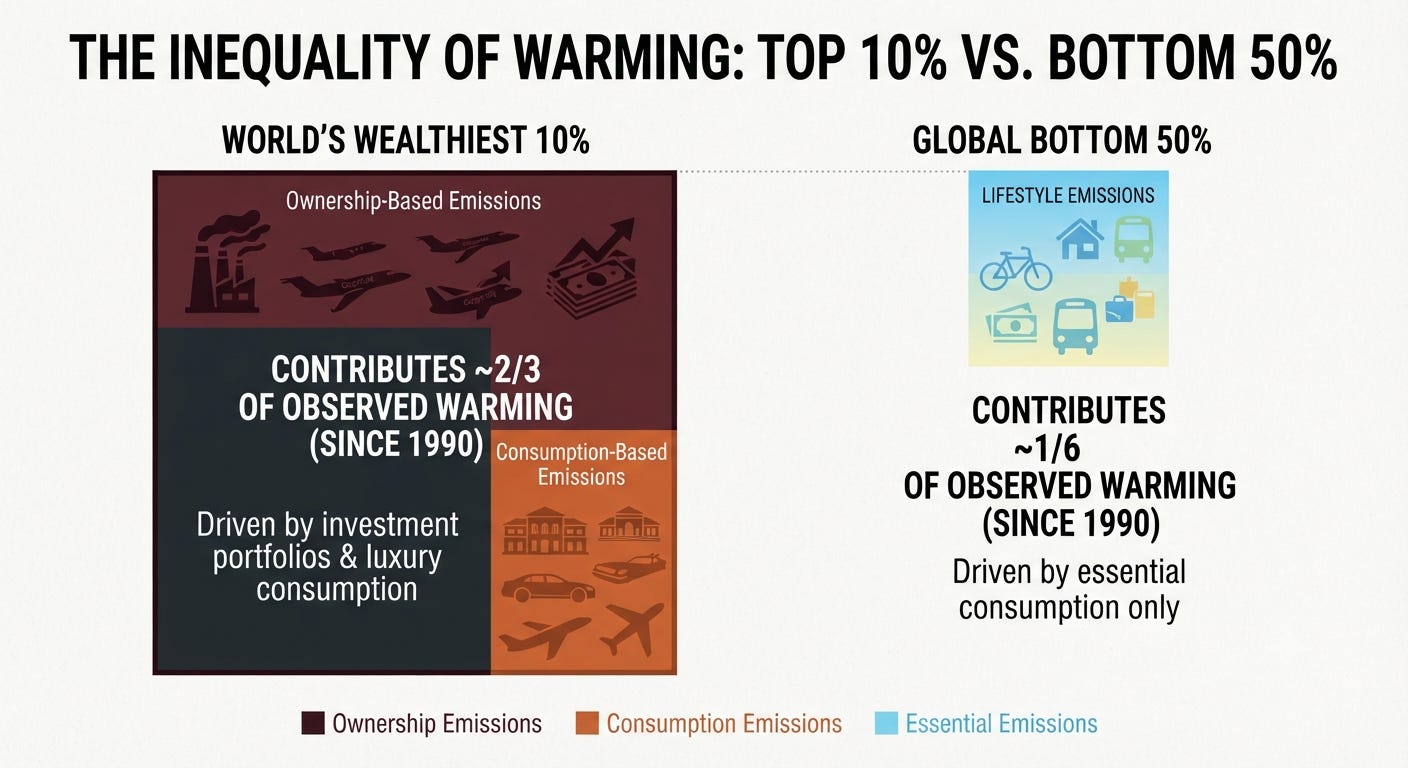
A 2025 study in Nature Climate Change found that the wealthiest 10 percent of the global population accounted for roughly two-thirds of the observed warming caused by emissions since 1990. The wealthiest 1 percent alone contributed close to a quarter of that warming. The bottom half of the world’s population contributed about a sixth.
The study, led by researchers at ETH Zurich and the Climate Analytics think tank in Berlin, used a modeling approach that traced emissions back to income groups and then forward into measurable climate outcomes, including specific heatwaves and droughts. It found that if the entire world had emitted at the rate of the wealthiest 10 percent, global temperatures would have risen by 2.9 degrees Celsius since 1990, compared to the 0.61 degrees actually observed. If everyone had emitted like the bottom half of the population, the increase would have been minimal.
Two mechanisms drive this gap. The first is consumption. Private jets, large homes, and frequent long-haul travel produce carbon footprints many times the global average. The second, and less discussed, is investment. A large share of emissions tied to wealthy individuals comes not from what they consume but from what they own, through equity stakes in oil, gas, aviation, and mining companies.
This second mechanism matters because it changes where responsibility sits. A factory’s emissions get counted at the factory. But the returns on that factory’s carbon-intensive operations often flow to shareholders sitting nowhere near a smokestack. Ownership-based emissions accounting, an approach gaining traction among researchers at the World Inequality Lab and elsewhere, tries to close that gap by tracing emissions to the capital that profits from them rather than only the operations that produce them.
Separate research published in the journal Social Currents looked at 26 high-income countries between 2000 and 2010 and found that wealth inequality, measured as the share of wealth held by the top decile, was consistently associated with higher per-capita emissions. The relationship held even after controlling for income inequality, which suggests wealth concentration specifically, not income differences generally, is doing the work.
Put plainly: emissions are not evenly distributed by population. They are heavily distributed by ownership.
The Strongest Counterargument Deserves an Honest Answer
China and India produce more total annual emissions than any wealthy Western nation, and their emissions continue to rise. That fact is real and does not contradict the wealth concentration argument. National emissions totals and wealth concentration describe different layers of the same system, because a large share of what gets manufactured in those countries serves export markets and multinational investment tied to wealthy consumers elsewhere.
This deserves a straight answer rather than a dodge. China’s annual emissions now exceed those of the United States and the European Union combined. India’s emissions are rising as its economy industrializes. Anyone arguing that concentrated wealth explains climate change has to account for that.
The traditional debate over national emissions creates a distorted view. To understand the full picture, we must decouple where the smoke rises from where the profit lands:
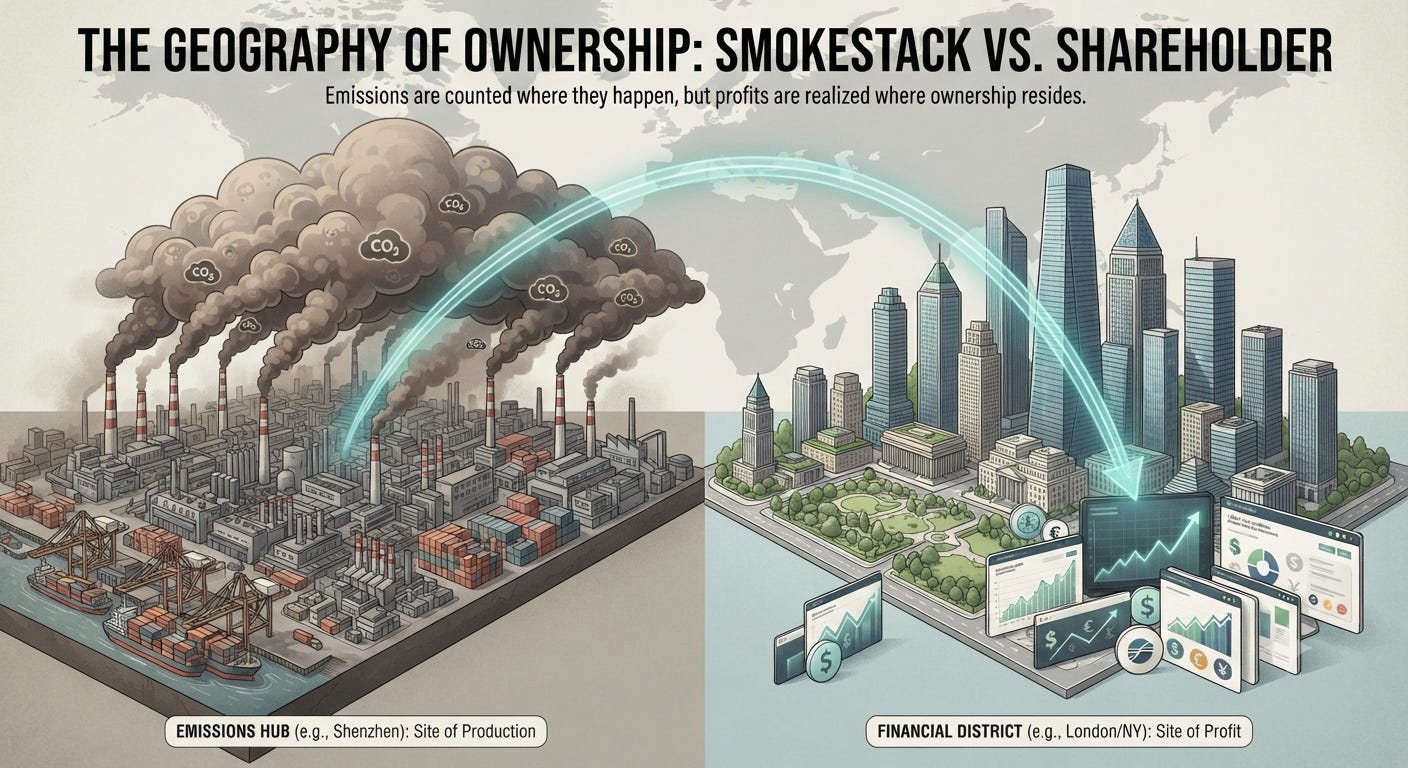
Multinational investment complicates the picture further. Wealthy investors, pension funds, and sovereign wealth funds hold stakes in carbon-intensive industries operating in developing economies. The emissions get counted where the smokestack stands. The financial return travels somewhere else entirely.
And within China and India themselves, inequality is rising fast. The Carbon Brief analysis of the Nature Climate Change study noted specifically high emissions coming from China’s growing upper and middle classes, alongside more modest contributions from the rest of the population. The same wealth-concentration pattern visible globally is now visible within these countries too.
None of this erases national responsibility. China and India both need credible decarbonization plans, and pretending otherwise would be dishonest. But treating national totals as the whole story, while ignoring where the profits from carbon-intensive production actually land, tells only half the story. The full picture requires both lenses at once.
How Concentrated Power Slows Climate Action
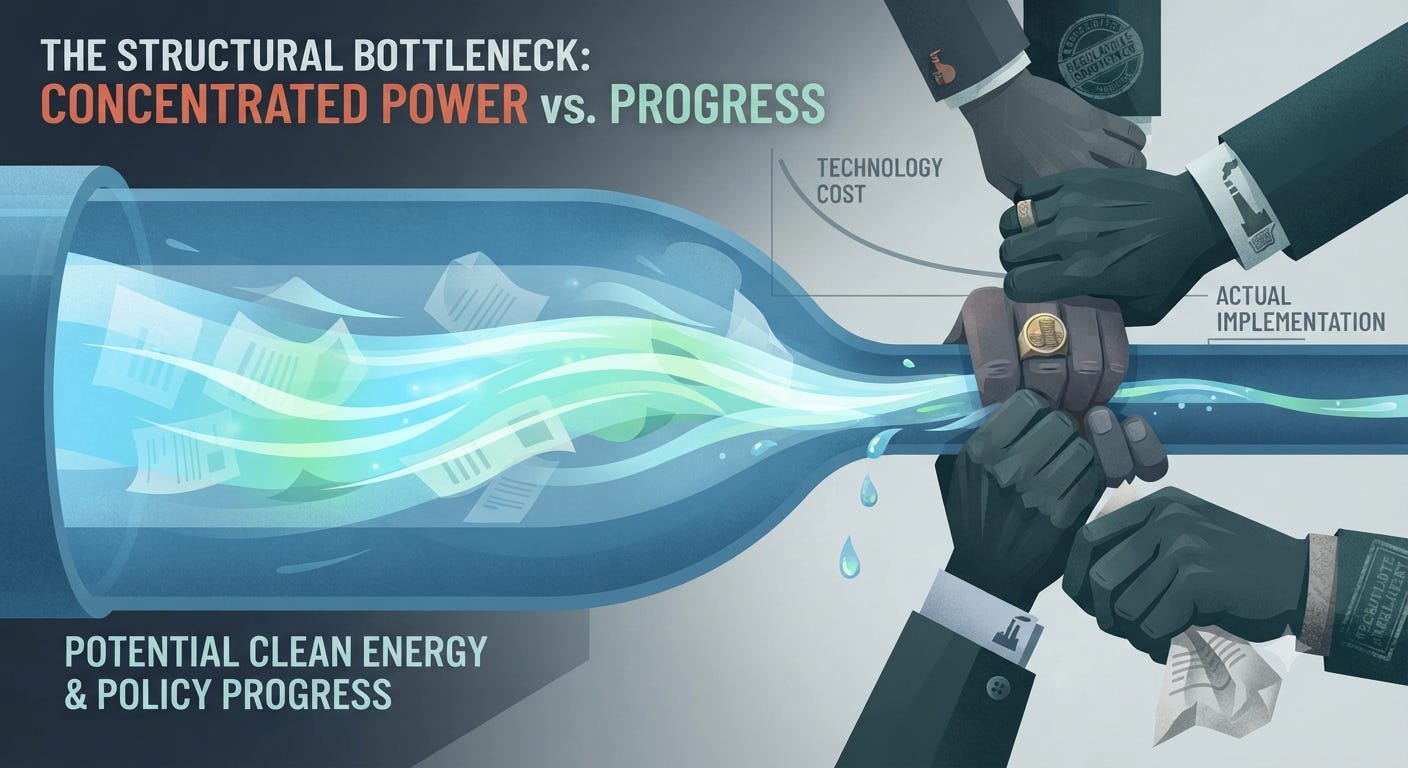
Wealth concentration translates into political influence through lobbying, campaign finance, and regulatory capture, and the fossil fuel industry has used all three for decades to delay climate legislation. We are not facing a mechanical failure; we are facing an institutional one. When you look at how lobbying and policy actually interface, the "delay" is better understood as a structural bottleneck:
Every industry lobbies. The distinguishing feature of fossil fuel lobbying is scale and duration. Internal industry documents made public through litigation over the past decade show that major oil companies understood the science of climate change by the late 1970s and early 1980s, decades before it became a matter of public debate. That knowledge did not translate into early disclosure. It translated into a multi-decade communications strategy designed to manufacture doubt about a question the industry’s own scientists had already answered.
Researchers who study this pattern describe a consistent playbook. Early strategies leaned on outright denial and questioning the science. As public opinion shifted and denial became less credible, the strategy evolved. Later approaches leaned on subtler tools: greenwashing through modest renewable investments framed as major commitments, “necessitarianism,” or the argument that fossil fuels remain simply unavoidable, and continued lobbying pressure applied through less visible channels.
The financial scale is not trivial. One analysis of European Union lobbying found that major oil companies and their trade associations spent roughly a quarter of a billion euros over a decade influencing EU climate policy, according to reporting cited by Corporate Europe Observatory. That kind of spending buys meetings, drafts language, and shapes which studies land on a regulator’s desk before a vote happens.
The same dynamic plays out closer to home, wherever a mine, pipeline, or dam sits on land whose ownership was never really settled. The question of who gets to decide how that land gets used, explored in what Land Back really means, is the same question of concentrated decision-making power showing up in a different jurisdiction.
Regulatory capture compounds the effect. When an industry becomes the primary source of technical expertise regulators rely on, and when former regulators routinely move into industry roles and back again, the line between rule-maker and rule-taker blurs. This is not corruption in the cartoonish sense of a bribe changing hands. It is a structural incentive, built quietly over the years, that delays the path of least resistance for everyone involved.
None of this requires a conspiracy. It requires only that concentrated wealth be able to buy concentrated access, and that access, applied consistently over enough election cycles, will always tilt outcomes toward whoever can afford to keep showing up.
Climate Skepticism Changed
Climate skepticism today is rarely outright denial of the physical science. It has shifted toward skepticism about the cost, pace, and fairness of proposed policy responses, and elite-funded messaging has played a documented role in shaping that shift.
It is tempting, and lazy, to treat every skeptical position as scientific ignorance. That framing flatters people who already agree with the consensus and insults everyone else, which is a poor way to win an argument.
The more accurate picture is that skepticism moved. Two decades ago, a meaningful share of public disagreement questioned whether warming was happening at all. Today, that share has shrunk considerably. What has grown instead is skepticism about regulation: whether a carbon tax will hit working families harder than corporations, whether rapid transition will cost jobs, and whether the people designing the policies have any stake in the outcome beyond their own careers.
Some of that skepticism is a reasonable response to real tradeoffs. Energy transitions do have costs, and those costs do land unevenly if policy is designed carelessly. But research into industry messaging campaigns, including work published in PLOS Climate examining coordinated social media activity across fossil energy, plastics, and agrichemical sectors, has documented deliberate efforts to reframe public discourse in ways favorable to continued fossil fuel use, separate from the underlying merits of any specific policy.
The effect is not that people get fooled into believing false things about physics. The effect is subtler. Elite-funded messaging shifts which frame feel normal, which solutions feel radical, and which costs feel unfair, long before most people ever encounter a peer-reviewed study. That is influence operating upstream of belief, and it is far more durable than outright denial ever was.
Climate Justice Begins With Carbon Inequality
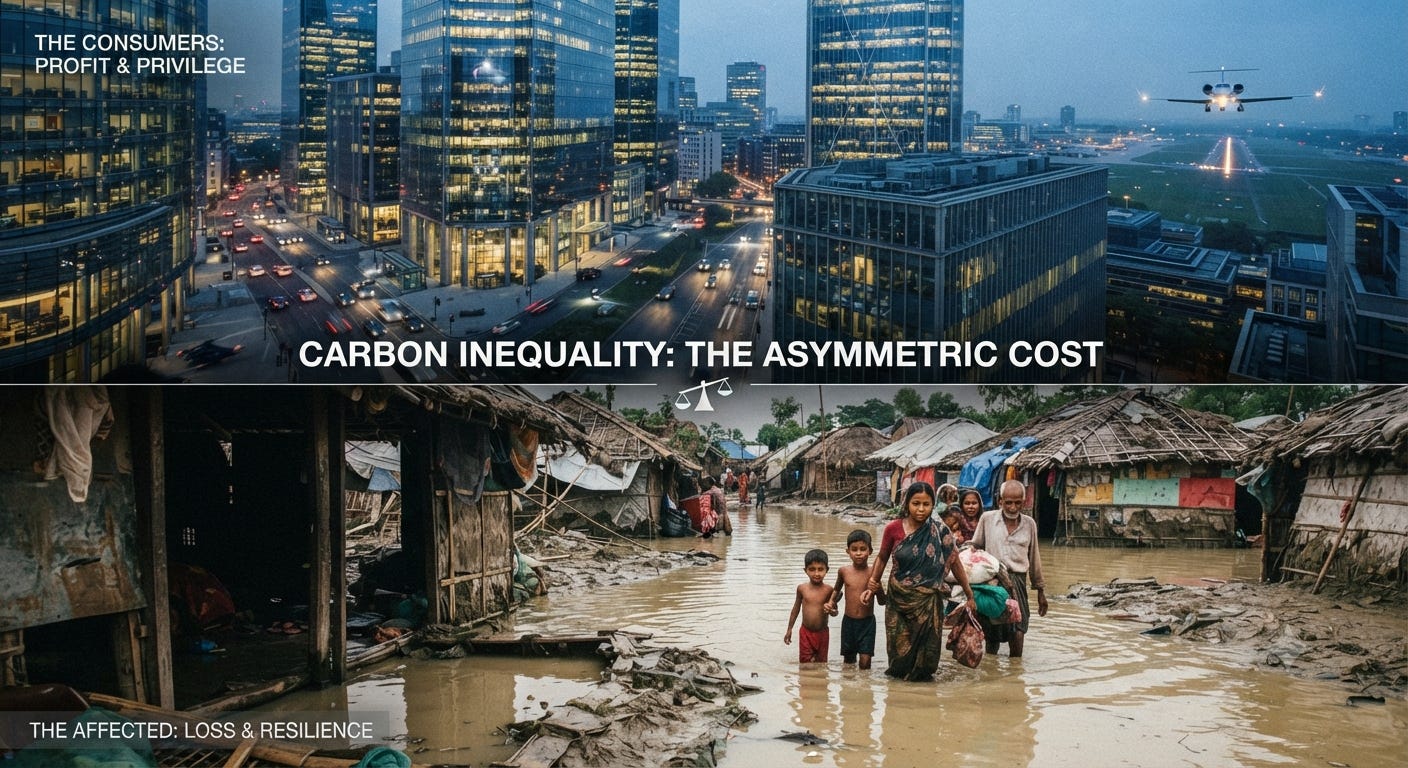
Carbon inequality describes the gap between who emits, who profits from those emissions, and who bears the resulting harm. The world’s poorest half of the population contributes roughly a tenth of global emissions yet faces the most severe and least buffered climate impacts, according to Oxfam and the IPCC.
Here is where the pattern closes its loop. The wealthiest 10 percent drive the majority of emissions-linked warming. Concentrated capital and political access have slowed the policy response for decades. And the people paying the steepest price for both facts are, overwhelmingly, the people who did the least to cause them. The throughline connecting who profits from extraction to who inherits its consequences is the same one I traced in how white supremacy shaped the climate crisis: the harm was never randomly distributed.
The IPCC’s Sixth Assessment Report states plainly that communities that have historically contributed the least to current climate change are disproportionately affected by it. Low-income countries, which the World Bank estimates produce roughly a tenth of global greenhouse gases, absorb a wildly disproportionate share of the resulting damage, measured in flood deaths, crop failure, water scarcity, and displacement.
This is not an abstraction. It shows up in specific, recent events. The 2022 floods in Pakistan displaced tens of millions of people in a country responsible for less than 1 percent of historical global emissions. Drought-driven food insecurity across the Sahel hits populations with some of the lowest per-capita carbon footprints on Earth. Within wealthy countries too, the EPA’s own research has found that low-income communities and communities of color face measurably higher exposure to climate-driven extreme heat and flooding than wealthier neighborhoods in the same cities, a pattern that echoes what I found writing about why Indigenous communities in Canada carry a disproportionate share of the country’s climate risk.
Carbon inequality is not a separate issue from climate change. It is the mechanism by which climate change gets distributed unfairly, and understanding that mechanism is what makes the political economy framing useful rather than academic. It explains not just why emissions concentrate at the top, but why the consequences concentrate at the bottom.
Frequently Asked Questions
Is capitalism responsible for climate change?
Not on its own. Competitive markets have driven real gains in clean energy costs and technology. The stronger evidence points to oligarchic capitalism specifically, meaning concentrated ownership and political influence, as the amplifying force behind slow climate action.
What is the difference between capitalism and oligarchy?
Competitive capitalism rewards new entrants and innovation through open markets. Oligarchic capitalism protects incumbents through concentrated ownership, regulatory capture, and control over media and lobbying access, which blocks the competitive pressure that would otherwise speed up change.
Does wealth inequality increase carbon emissions?
Research across high-income countries has found a consistent, positive relationship between wealth concentration and per-capita emissions, independent of income inequality. Global research also shows the wealthiest 10 percent are responsible for roughly two-thirds of warming-related emissions since 1990.
Why do wealthy people have larger carbon footprints?
Two reasons. Consumption, including private aviation, large residences, frequent travel, and investment, since a large share of wealth-linked emissions comes from equity ownership in carbon-intensive industries like oil, gas, and mining.
How does lobbying affect climate policy?
Sustained, well-funded lobbying has been linked to delayed emissions trading policy, weakened renewable energy targets, and slower regulatory action across multiple jurisdictions, including documented spending by major oil companies on EU climate policy.
Why are poorer countries more vulnerable to climate change?
Lower-income countries and communities have fewer resources for disaster recovery, weaker infrastructure, and greater reliance on climate-sensitive sectors like agriculture and fishing, even though they contribute a small share of global emissions.
What is carbon inequality?
Carbon inequality describes the gap between who produces emissions, who profits from the activity that produces them, and who experiences the resulting climate harm. The IPCC and multiple independent studies confirm that those three groups rarely overlap.
Can climate change be solved without reducing inequality?
Unlikely, according to the research on wealth-linked emissions and political influence. Technology can reduce the cost of clean energy, but concentrated wealth has repeatedly shown the capacity to slow adoption through political access, regardless of how cheap the alternative becomes.
The Question Underneath the Question
Go back to where this started. If the science has been clear for decades, why has progress moved so slowly?
The honest answer is not that people don’t understand climate change. It is that some people have understood it very well, for a very long time, and have used that understanding to protect what they own rather than to change what they do.
Humanity’s greatest climate challenge was never inventing better technology. The technology arrived years ago, cheaper and more capable every year. The real challenge is deciding who holds enough power to decide whether those technologies actually get used, at the pace the physics requires, rather than the pace that protects existing wealth.
That is not a question for scientists to answer. It is a question about power, and it belongs to everyone who has ever wondered why the future keeps arriving slower than it should.
If this raised more questions than it answered, that was the point. Keep reading: What Land Back Really Means, and Why, Why Indigenous Communities in Canada Face Disproportionate Climate Risk, and How White Supremacy Created the Climate Crisis.
Thanks for Reading
Buy Me A Coffee |Gumroad| Medium
Gregory Bourne writes at the intersection of analog life and digital power, crafting frameworks for people who weren’t supposed to be part of the tech conversation. A published author and AI consultant, he helps Black solopreneurs and midlife founders build robust digital systems without compromising human judgment.
👉 Learn more and get the frameworks at feralgeneration.substack.com.