
How Memory Shapes Moral Judgment: Why Good People See the Same Tragedy Differently
Why memory, not facts, decides how good people judge the same event


Photo by Christina @ wocintechchat.com M on Unsplash
Two people watch the same video.
They read the same headline. They hear the same speech. They sit in the same room and absorb the same set of facts.
One walks away certain that justice was served. The other walks away, certain that justice failed. Neither is lying. Neither is stupid. Neither has seen anything the other missed.
So why do they leave with opposite conclusions?
The honest answer is that people don’t experience events directly. They experience events through memory. Before any new information reaches conscious thought, the brain has already compared it against a lifetime of stored experience, inherited stories, and emotional associations. That comparison happens first. The judgment comes after.
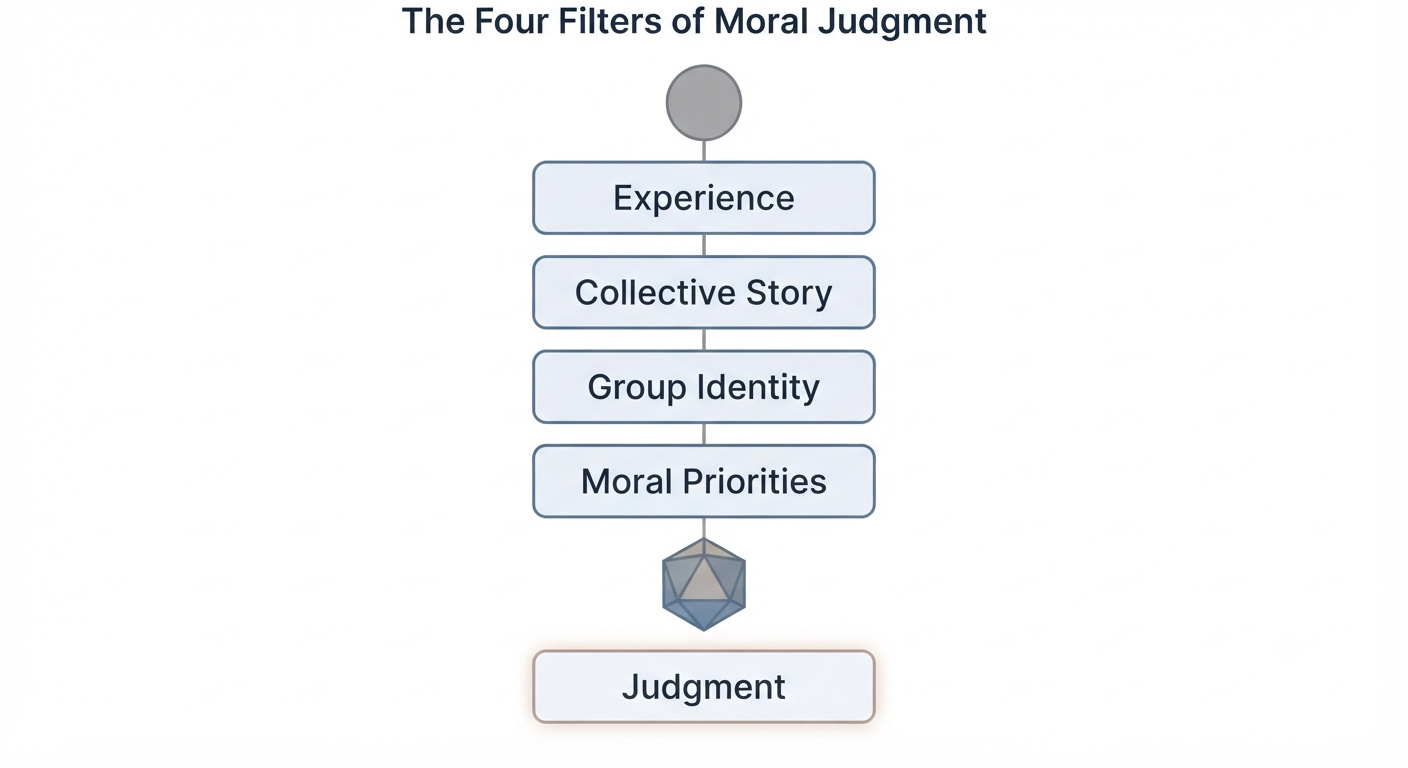
This isn’t a flaw in human reasoning. It’s how reasoning works. Memory doesn’t just record the past. It builds the lens through which the present gets interpreted. This article introduces a simple framework, the Four Filters of Moral Judgment, for understanding that lens: personal memory, collective memory, identity, and moral priorities. Every opinion passes through all four before it ever reaches the surface as a conclusion.
Executive Summary
Moral disagreement rarely begins with facts alone. Research from cognitive psychology, moral psychology, and collective memory suggests people interpret events through personal experience, inherited narratives, identity, and moral priorities. This article explains why two sincere people can witness the same event and reach opposite conclusions without assuming either is acting in bad faith. It introduces the Four Filters of Moral Judgment, a framework for tracing a disagreement back to where it actually starts, and applies that framework to business, politics, relationships, leadership, negotiation, and everyday conflict.
Key Takeaways
● Memory is not a recording device. It actively shapes how people interpret new information, before conscious reasoning begins.
● Communities inherit collective memories, shared stories, symbols, and emotional associations that shape identity long before individuals form political opinions.
● Collective trauma changes which moral values feel most urgent to a given community, whether that’s security, freedom, fairness, or loyalty.
● Identity influences how people evaluate evidence, a pattern researchers call identity-protective cognition.
● Facts rarely settle disagreements on their own, because they compete with memory and identity long before they compete with reason.
● Understanding another person’s perspective does not require agreeing with their conclusion.
● The Four Filters of Moral Judgment, personal memory, collective memory, identity, and moral priorities, offer a practical way to locate where a disagreement actually begins.
Do We Really See Reality, Or Just Our Story Of It?
We tend to treat perception as a kind of camera. Point it at an event, and it records what happened.
That’s not what perception does.
Perception is active, not passive. The brain doesn’t simply intake information. It searches memory for similar situations, retrieves relevant expectations, and uses that stored material to decide what the new information means. Cognitive research on memory and decision-making describes this as a constant, largely unconscious process, one where prior experience shapes which details get noticed, which get ignored, and which get remembered afterward. Memory plays a key role in decision-making because people are constantly choosing among alternatives, and because so many of those decisions happen unconsciously, information about how a past decision was made gets stored and reused for future ones. In other words, you are never evaluating a new situation from scratch. You are evaluating it against a running archive of everything that came before.
People rarely interpret events directly. They interpret events through memory, identity, and moral priorities.
This matters more than it sounds. If two people carry different archives, the same event won’t just feel different to them. It will mean something different.
Psychologists call one version of this the congruency effect: information that matches what someone already expects gets processed more easily and remembered more vividly than information that contradicts it. Pair that with confirmation bias, the well-documented tendency to seek out and favor evidence that supports existing beliefs, and you get a simple but uncomfortable picture. People aren’t randomly sampling reality. They’re filtering it.
None of this means people are irrational. It means rationality itself runs on borrowed material. We don’t encounter facts in isolation. We compare them with thousands of earlier experiences before we’re able to assign them any meaning at all.
Why This Matters
Before asking who is right in a disagreement, ask how each person learned to see the world. The second question usually explains the first.
If individual memory shapes perception this strongly, what happens when an entire community remembers together? That’s the first of the Four Filters: personal memory. The second is collective memory, and it’s larger, older, and harder to see.
What Is Collective Memory, And Why Does It Matter?
Collective memory is the shared understanding of the past that a group carries forward, not as a list of agreed-upon facts, but as a living, socially reinforced set of stories, symbols, and emotional associations.
The concept comes from Maurice Halbwachs, a French sociologist working in the early twentieth century. Halbwachs studied under the philosopher Henri Bergson and the sociologist Émile Durkheim, and his central contribution was the claim that individual memory itself depends on social context. Research published in Frontiers in Psychology on the sociology of memory explains that Halbwachs argued that memory is acquired within social frameworks and reflects a social process rooted in the present, rather than a neutral record of the past. Families, religious communities, schools, and nations all provide what he called frameworks, reference points that shape which memories get preserved and which quietly disappear. His central claim was that human memory can only function within a collective context, and that because different groups carry different collective memories, those groups develop different patterns of behavior.
This is worth sitting with, because it means memory is never just personal. Long before you form a political opinion, you’ve already absorbed a version of history from your family’s dinner-table stories, your school’s curriculum, the monuments in your city, and the anniversaries your community chooses to observe.
Think about how differently Remembrance Day, a Holocaust commemoration, a Civil Rights anniversary, or a Truth and Reconciliation ceremony can feel depending on which community you grew up in. The historical facts underneath these events are documented and knowable. But the emotional weight attached to them, what they represent, who they honor, what lesson they’re meant to teach, is transmitted socially, generation after generation, largely outside of conscious debate.
It’s worth being precise here. Collective memory is not the same thing as history. History aims to reconstruct what happened, as accurately as the evidence allows. Collective memory is about what a community chooses to carry forward emotionally, and that choice is shaped as much by present needs and present identity as by the past itself. A community can accurately know its history and still disagree, sometimes sharply, with another community about what that history means.
Every opinion has a family tree. Trace it back far enough, and you rarely find a fact. You find a memory someone decided was worth keeping.
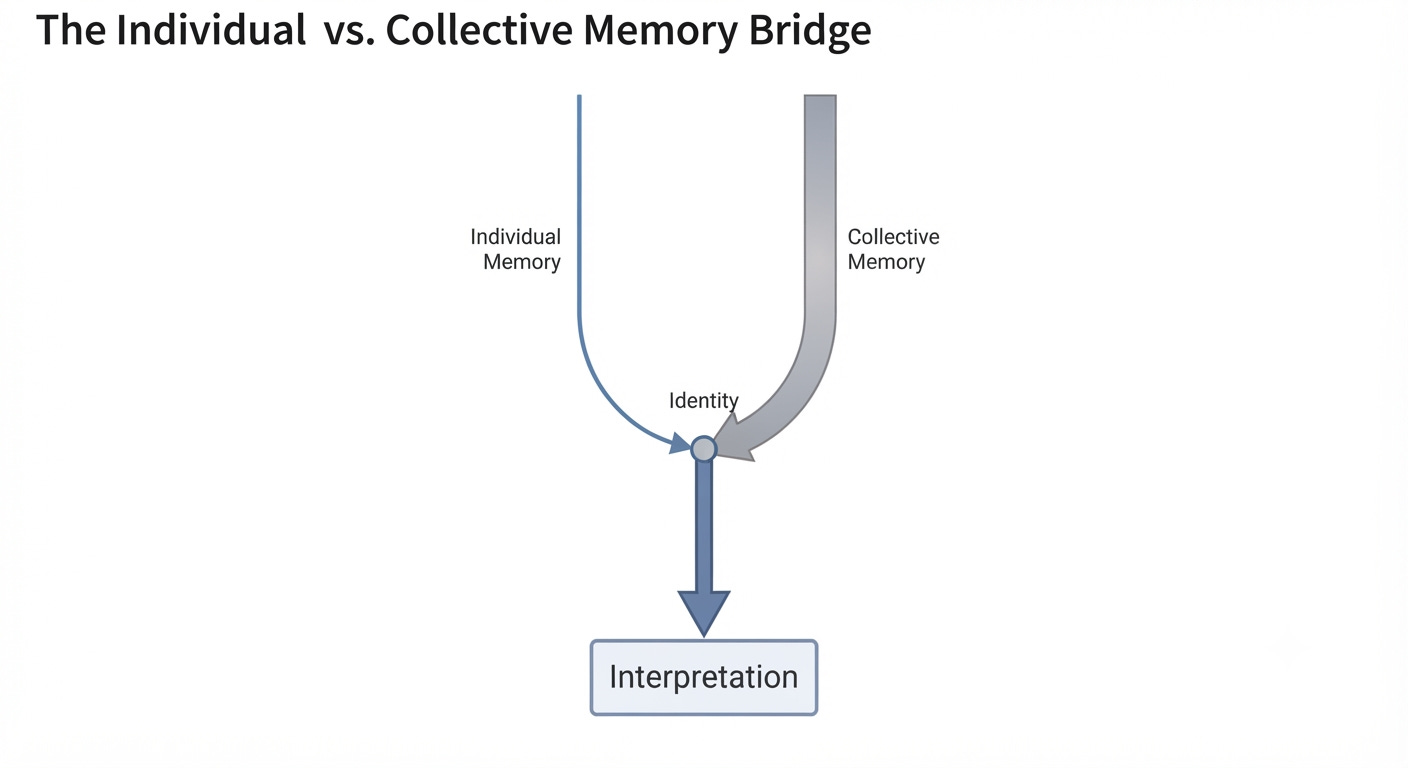
This is how entire groups can inherit fear, pride, grievance, or resolve before any of their individual members have personally lived through the event being remembered. And once a community inherits that emotional charge, it has to go somewhere. It becomes the third filter: identity. Before it does, it usually passes through a fourth force that reorders what a community values most. That force is trauma.
How Does Trauma Change What We Call Moral?
Trauma doesn’t just leave a mark on memory. It reorders priorities.
When a community has repeatedly experienced threat, loss, displacement, or violation, certain values start to feel more urgent than others. Security starts to feel non-negotiable. Or freedom does. Or loyalty, or justice, or purity of tradition. The disagreement two people have today often didn’t start today. It started with which value their respective histories taught them to protect first.
Moral Foundations Theory is a framework in moral psychology proposing that human morality rests on a small set of shared, innate intuitions, which cultures then build into different virtues, narratives, and institutions. It was developed primarily by Jonathan Haidt, a social psychologist, along with Jesse Graham and colleagues, building on the anthropologist Richard Shweder’s earlier cross-cultural work on morality. In its current form, the theory identifies six foundations: care versus harm, fairness versus cheating, loyalty versus betrayal, authority versus subversion, sanctity versus degradation, and liberty versus oppression.
The plain-English version is simpler than it sounds. Most people value all of these things to some degree. They differ in which ones they rank first when values come into conflict, and that ranking is shaped by experience, including collective experience.
It’s worth being cautious here. Moral Foundations Theory is influential, but it isn’t the only account of moral psychology, and it has real critics. A critique published in Behavioral Scientist argues that the framework was built without a clear underlying theory of why these particular foundations exist, and that it leaves out other well-documented forms of human cooperation. Haidt himself has revised the theory over time, adding a foundation after the original five and remaining open to further changes. Treat it as one useful lens, not a settled law of human nature.
Still, the underlying pattern holds up across many accounts of moral psychology: communities that have experienced sustained threat tend to weigh security and loyalty more heavily. Communities that have experienced sustained injustice tend to weigh fairness and liberty more heavily. Neither group is wrong to care about what it cares about. But when two groups with different histories look at the same event, they aren’t just applying different facts. They’re applying different weighting systems to the same facts, and the outputs won’t match.
Different priorities produce different interpretations. Different interpretations produce competing stories. And competing stories tend to produce the same complaint, voiced by everyone involved.
Common Misunderstanding
Understanding someone’s history does not mean approving of their actions. Explaining a moral priority is not the same as excusing what someone did with it.
Why Does Every Side Say, “If Only They Knew Our History”?
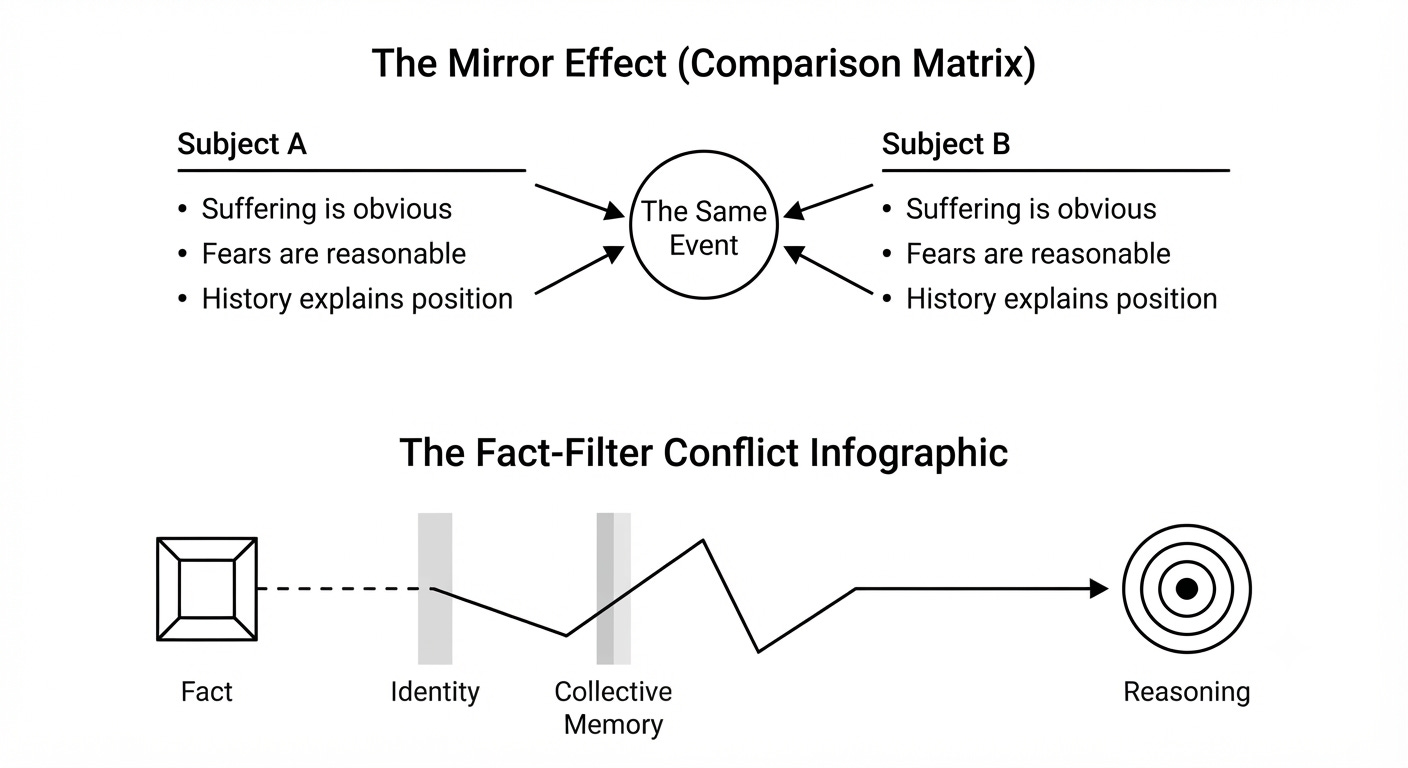
Here’s a pattern worth naming, because once you see it, you can’t stop noticing it. Call it the Mirror Effect.
Groups in conflict tend to believe a specific set of things about themselves. Our suffering is obvious. Our fears are reasonable, given what we’ve lived through. Our history explains our position, and if the other side just understood that history, they’d understand us.
The uncomfortable part isn’t that this belief is wrong. It’s that the opposing group usually believes the same thing about itself, with the same sincerity, often using nearly identical language.
This isn’t coincidence. It’s what happens when identity-protective cognition meets collective memory. Identity-protective cognition is the unconscious tendency to process evidence in ways that protect a person’s connection to a valued social group, rather than in ways that maximize accuracy. The concept comes from Dan Kahan, a professor at Yale Law School who has spent years studying how people process evidence on contested issues through his Cultural Cognition Project. Kahan’s research found that people don’t evaluate information neutrally when it touches their group identity, evaluating evidence not by its quality but by whether its conclusions support or threaten that identity. Layer that onto a community’s collective memory, its own inherited story of grievance or vindication, and you get two sides who each experience themselves as the reasonable ones surrounded by people who refuse to listen.
This is worth stating plainly, because it’s easy to misread: noticing that both sides experience this same psychological pattern is not the same as claiming both sides carry equal responsibility, or that every conflict is morally symmetrical. Perception can be symmetrical while actions and outcomes are not. The Mirror Effect describes how people feel misunderstood. It says nothing about who is right.
What it does explain is why appeals to “just look at the facts” so rarely end an argument. By the time two people are arguing, the facts have already been filtered through years of inherited story. The argument was never only about the facts.
If stories become part of identity, then facts start competing with identity, and identity usually has the home-field advantage.
Why Facts Alone Rarely Change Minds
Here’s a sentence worth sitting with: people rarely reject facts because they lack intelligence. They reject facts because those facts threaten a story that helps explain who they are.
Facts compete with memory long before they compete with reason.
This isn’t just intuition. Motivated reasoning is the tendency to reason toward conclusions that align with existing beliefs or group identity, sometimes using analytical skill to defend a preferred conclusion rather than to test it. Kahan’s research on what he calls motivated numeracy found something counterintuitive. When a problem touched people’s political identity, greater math skills didn’t make people more accurate. It made them better at reaching the conclusion their group already favored. People with more scientific literacy became more polarized on identity-relevant topics, not less, because greater analytical ability gets used to construct better arguments for the identity-consistent position rather than to evaluate evidence more objectively.
It’s worth noting that this specific finding hasn’t gone unchallenged. A 2021 replication study published in the journal Cognition found weaker support for the effect than the original study reported, and researchers still debate exactly how strong motivated reasoning is and under what conditions it appears. That uncertainty is itself instructive. Even psychologists who study this phenomenon closely don’t fully agree on its size or its mechanism. What they do largely agree on is the direction: identity shapes how people process information that touches their sense of self, even when that information is quantitative and, on its face, neutral.
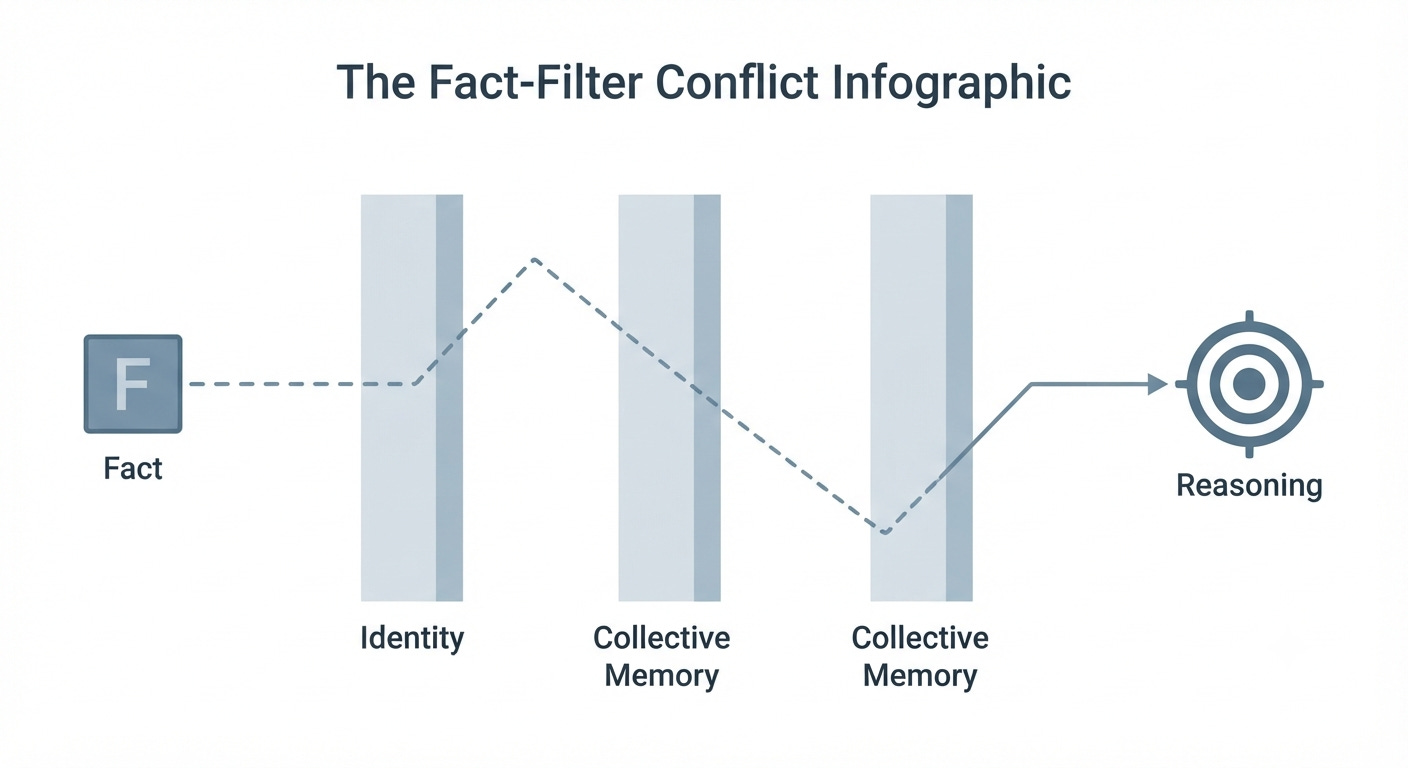
Memory research adds another layer. Studies on memory bias in decision-making show that what people remember about their own past choices, and how confident they feel in those memories, measurably shape the choices they make next, sometimes independent of whether the memory is accurate. A study published in Scientific Reports found that beliefs about memory, not just memory itself, drive behavior forward.
Put these threads together, and a clearer picture forms. A fact that contradicts your community’s collective memory doesn’t just ask you to update a data point. It asks you to question a story that explains who your people are, what they’ve suffered, and why their priorities are the right ones. Memory explains the person, before opinion explains the argument, and that’s a much bigger ask than most fact-checks account for.
None of this means people always reject evidence, or that persuasion is impossible. It means persuasion that ignores identity is fighting with one hand tied behind its back.
The Four Filters of Moral Judgment
Every moral judgment passes through four filters before it becomes a conclusion. This is the article’s central framework, and it’s worth treating as a working tool rather than a one-time observation.
Filter One: Personal Memory. What you, individually, have lived through. Your own experiences of safety, loss, fairness, and threat.
Filter Two: Collective Memory. What your community has lived through and passed down, through family stories, education, commemoration, and shared symbols.
Filter Three: Identity. Who you understand yourself to be, and which groups you feel connected to, protective of, and responsible toward.
Filter Four: Moral Priorities. Which values, security, freedom, fairness, loyalty, and the rest, feel most urgent to you when they come into tension with one another.
By the time an opinion reaches the surface, it has already passed through all four. Two people can look at identical evidence and run it through entirely different filters, and reach conclusions that feel, to each of them, obviously correct.
This doesn’t mean all conclusions are equally justified once you understand the filters. It means the disagreement usually starts further upstream than most arguments assume. Most arguments begin years before the conversation starts, and the Four Filters are a way of tracing an argument back to where it actually began.
The Four Filters in Business
A merger fails not because the financial logic was wrong, but because one company’s culture was built on a memory of scarcity and the other’s on a memory of abundance. The same cost-cutting proposal reads as prudent to one team and threatening to the other.
The Four Filters in Politics
Two voters can look at the same policy and run it through different priority filters, one weighting security first, the other weighting fairness first, and reach opposite conclusions without either misreading a single statistic.
The Four Filters in Relationships
A couple argues about money. The argument is rarely about the number. It’s about what each partner’s family history taught them money is for: safety, freedom, status, or control.
The Four Filters in Leadership
A leader who grew up in a high-accountability, low-trust environment will instinctively build systems of control. A leader shaped by a high-trust environment will instinctively build systems of autonomy. Neither is wrong. Both are running their own filters.
The Four Filters in Negotiation
The most effective negotiators don’t just ask what the other side wants. They ask what memory is shaping what the other side is afraid to lose.
The Four Filters in Conflict
Most conflicts that look intractable aren’t disagreements about facts at all. There are disagreements between different filter stacks, arguing as if they were disagreements about evidence.
How This Changes Everyday Conversations
The Four Filters aren’t just an abstract model. They show up in ordinary moments.
Family disagreements. A holiday argument about politics is rarely about the news story that triggered it. It’s usually two family members running the same headline through different personal and collective memories.
Workplace conflict. A disagreement about a decision often hides a disagreement about which moral priority, speed, fairness, loyalty to the team, or security of the plan, should win when they conflict.
Social media. Outrage spreads faster than context because platforms reward the fastest filter, identity, over the slowest one, personal reflection.
Journalism. Two readers can accuse the same article of bias in opposite directions, not because the reporting changed, but because each reader’s filters flagged different details as significant.
Education. Students don’t arrive as blank slates. They arrive with collective memories already in place, which is why the same historical lesson can land as validation for one student and as erasure for another.
We often expect facts to settle arguments. Family holiday dinners suggest otherwise.
Can Understanding Exist Without Agreement?
Yes, and this distinction matters more than it might seem.
Perspective-taking, the deliberate effort to understand a situation from another person’s point of view, is a well-studied tool in conflict research. Research on perspective-taking in conflict resolution suggests it can reduce hostility and open space for dialogue between opposing groups, not by erasing disagreement, but by helping each side recognize the other as reasoning from a coherent, if different, set of experiences.
That’s a very different goal than agreement. You can fully understand why someone concluded, understand the memory, the identity, the moral priority behind it, and still believe that the conclusion is wrong. Cognitive empathy, understanding someone’s internal logic, doesn’t require moral endorsement of where that logic leads.
This is probably the most practically useful idea in the whole framework. Most people treat understanding and agreement as a package deal, so they resist understanding the other side because they’re afraid it will be mistaken for surrender. It won’t. You can say, “I understand why your history led you here,” and follow it immediately with, “and I still think you’re wrong,” without contradiction. Separating those two acts is what allows a real conversation to happen instead of two monologues delivered at increasing volume.
What Story Would You Have to Inherit?
Here’s the question worth carrying away from all of this: what story would you have to inherit to see the world the way someone else does?
What facts would you need. What memories. What community. What history of fear, loss, pride, or vindication would need to sit underneath your reasoning before their conclusion started to look, to you, like the obvious one.
That question doesn’t resolve moral disagreement. It was never going to. But it explains why disagreement so often survives contact with facts, and why two sincere people can watch the same tragedy and walk away certain of opposite things.
Every generation inherits more than language, traditions, and customs. It inherits ways of seeing. That’s why history continues long after the history books close.
We don’t inherit opinions. We inherit the stories that make those opinions feel inevitable.
Frequently Asked Questions
What is collective memory?
Collective memory is the shared understanding of the past that a community carries forward through institutions, rituals, and stories, shaped as much by present identity as by historical fact.
Is collective memory different from history?
Yes. History aims to reconstruct what happened as accurately as the evidence allows. Collective memory is about what a community chooses to carry forward emotionally, which is shaped by present identity as much as by the past.
How does memory influence moral judgment?
Memory supplies the stored experiences and expectations the brain uses to interpret new information, which means moral conclusions are shaped by personal and collective history before conscious reasoning begins.
How does collective trauma influence beliefs?
Sustained experiences of threat, loss, or injustice reorder which moral values a community treats as most urgent, which shapes how that community interprets new events long after the original trauma has passed.
Why do facts fail to change some opinions?
Facts that threaten a story tied to someone’s identity are processed defensively rather than neutrally, a pattern researchers call identity-protective cognition.
What is identity-protective cognition?
It’s the tendency to process evidence in ways that protect a person’s connection to a valued social group, rather than in ways that maximize accuracy.
What is motivated reasoning?
The tendency to reason toward conclusions that align with existing beliefs or group identity, sometimes using analytical skill to defend a preferred conclusion rather than to test it.
Can people overcome identity-protective cognition?
Research suggests it can be reduced but rarely eliminated. Approaches that lower the identity stakes of a topic, rather than simply adding more information, tend to be more effective than fact-based appeals alone.
Why do intelligent people disagree?
Intelligence and analytical skill are often used to build stronger arguments for a conclusion someone already favors, rather than to test that conclusion objectively, particularly on topics tied to identity.
Can facts ever change minds?
Yes, but research suggests facts are more persuasive when they don’t threaten a person’s identity or collective memory. Framing matters as much as accuracy.
What is Moral Foundations Theory?
A framework developed by Jonathan Haidt and colleagues proposes that human morality rests on a small set of shared intuitive foundations, such as care, fairness, loyalty, authority, sanctity, and liberty, weighted differently across individuals and cultures.
How does perspective-taking reduce conflict?
Research suggests that deliberately imagining a situation from another person’s point of view can reduce hostility and open space for dialogue, without requiring either side to change its underlying position.
What is the Four Filters of Moral Judgment framework?
An original framework describing the four filters, personal memory, collective memory, identity, and moral priorities, that every moral judgment passes through before it becomes a conclusion.
Does understanding someone’s perspective mean agreeing with them?
No. Cognitive empathy, understanding the internal logic behind someone’s position, is separate from moral endorsement of that position.
Sources & Further Reading
Memory and decision-making
Alba, J. W., Hutchinson, J. W., & Lynch, J. G. — foundational review on memory’s role in choice; overview via Memory and decision-making, Wikipedia summary of the preferences-as-memory framework.
https://en.wikipedia.org/wiki/Memory_and_decision-making
The Multifold Relationship Between Memory and Decision Making
Individual-differences study on memory processes underlying judgment and decision tasks.
https://pmc.ncbi.nlm.nih.gov/articles/PMC4160880/
Collective memory: between individual systems of consciousness and social systems
Frontiers in Psychology — builds on Maurice Halbwachs’s theory of collective memory and social frameworks.
https://pmc.ncbi.nlm.nih.gov/articles/PMC10603192/
Halbwachs, Maurice — On Collective Memory (trans. Lewis A. Coser)
University of Chicago Press.
https://press.uchicago.edu/ucp/books/book/chicago/O/bo3619875.html
Kahan, Dan M. — Identity-Protective Cognition
The Cultural Cognition Project, Yale Law School.
https://www.culturalcognition.net/
Kahan, Dan M. — Motivated Numeracy and Enlightened Self-Government
Persson, E., Andersson, D., Koppel, L., Västfjäll, D., & Tinghög, G. — A preregistered replication of motivated numeracy
Cognition, 2021 — cited here for the mixed replication evidence on motivated numeracy.
https://www.sciencedirect.com/science/article/pii/S0010027721001876
Haidt, Jonathan, Graham, Jesse, et al. — Moral Foundations Theory
MoralFoundations.org.
https://moralfoundations.org/
Curry, Oliver Scott — What’s Wrong with Moral Foundations Theory, and How to Get Moral Psychology Right
Behavioral Scientist — cited here for the critique of Moral Foundations Theory.
Perspective-taking in conflict resolution
PMC research overview on perspective-taking and intergroup conflict.
https://pmc.ncbi.nlm.nih.gov/articles/PMC6166753/
Memory bias in value-based decisions
PMC research overview.
https://pmc.ncbi.nlm.nih.gov/articles/PMC9846459/
Memory beliefs shape decisions
Scientific Reports, Nature.
https://www.nature.com/articles/s41598-018-28728-9
Thanks for Reading
Buy Me A Coffee |Gumroad| Medium
Gregory Bourne writes at the intersection of analog life, digital power, and pop culture for people who weren’t supposed to be part of the tech conversation. A published author and AI consultant, he helps Black solopreneurs and midlife founders build robust digital systems without compromising human judgment. Also, a pop culture connoisseur.