
Shadowbanned or Self-Censored?
How Meta's Moderation Uncertainty Shapes Creator Behavior

Photo by Videodeck .co on UnsplashEpisode #109
Why is your Instagram engagement suddenly dropping? That question gets asked thousands of times a day. Most creators looking for an answer suspect the same thing: the platform is suppressing them. Maybe quietly. Maybe intentionally. Maybe because of something they posted.
The harder question is not whether that suspicion is correct.
The harder question is what happens when creators cannot find out either way.
Uncertainty is not a neutral condition. When visibility determines income, and moderation systems are opaque, uncertainty becomes a business risk. Creators respond to business risk the same way anyone does: they change their behavior to reduce it.
That behavioral change is the real story. Not secret censorship. Not a broken algorithm. The story is what opaque systems do to the people operating inside them.
What Is Instagram Shadowbanning?
Gemini AI Image
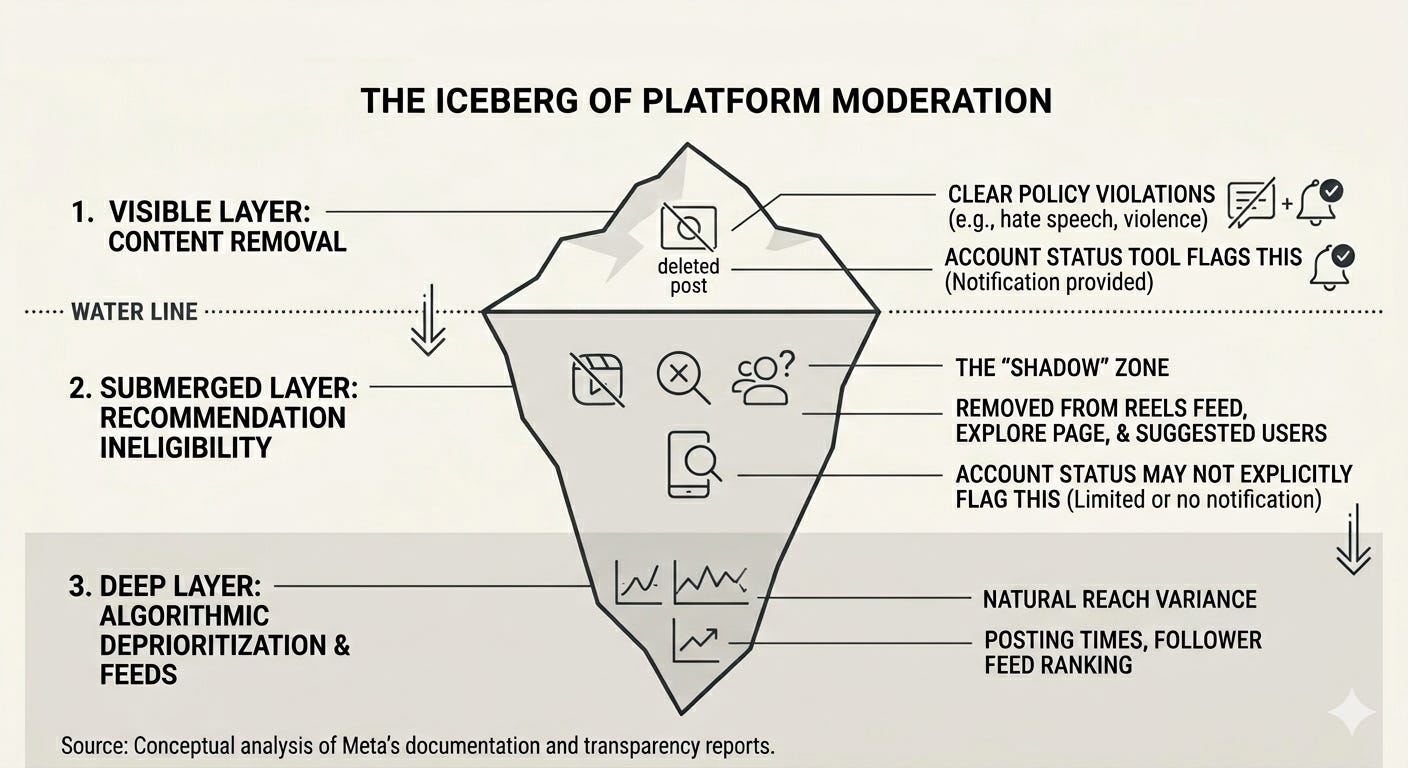
“Shadow suppression” or “shadowbanning” refers to the practice of a platform reducing a creator’s visibility without clearly notifying them. No warning. No policy notice. There is no clear explanation for why the reach declined.
The term comes from older internet forums, where disruptive users were made invisible to others but could still see their own posts. The mechanism implied deliberate, covert punishment.
On Instagram and other Meta platforms, the reality is more complicated.
Meta does not use the word “shadowban.” What it does have is a documented system of recommendation eligibility that controls whether content appears in spaces like Explore, Reels recommendations, and hashtag feeds. Content that violates community guidelines, or that is flagged as sensitive, may be removed from those surfaces entirely.
This may include reduced feed distribution, hashtag invisibility, recommendation removal, content deprioritization, and discoverability limits. Meta’s Transparency Center documents some of these mechanisms, including how content is ranked, removed, or restricted.
The issue is not that these systems exist. Moderation systems are necessary.
The issue is that creators often cannot tell when they have been affected, why it happened, or what they can do about it.
Not every reach drop is suppression. Algorithmic changes, posting time, audience behavior, platform-wide shifts, and content quality all affect performance. Instagram’s Account Status tool gives creators some visibility into whether their account has restrictions. But for many creators, that tool raises as many questions as it answers.
Why Creators Believe Their Reach Is Being Suppressed
Gemini AI Image
The symptoms are consistent enough that they have become a recognizable pattern in the creator community.
A post performs normally for the first hour, then engagement drops sharply. Reels that previously reached tens of thousands of non-followers stop performing. Hashtags that used to drive discovery stop delivering traffic. An account that grew steadily for months hits a wall with no apparent cause.
Common signals creators cite include sudden and unexplained engagement collapse, content performing well internally but showing no external reach, policy notices with minimal explanation, and appeal processes with limited feedback on outcomes. [Research on platform governance confirms] that these experiences are not isolated complaints. They reflect a structural pattern in how algorithmic systems interact with creators who discuss politically sensitive or socially contested topics.
Platforms do deprioritize certain content. That is not disputed. What is disputed is the scope, the triggers, and the consistency of enforcement.
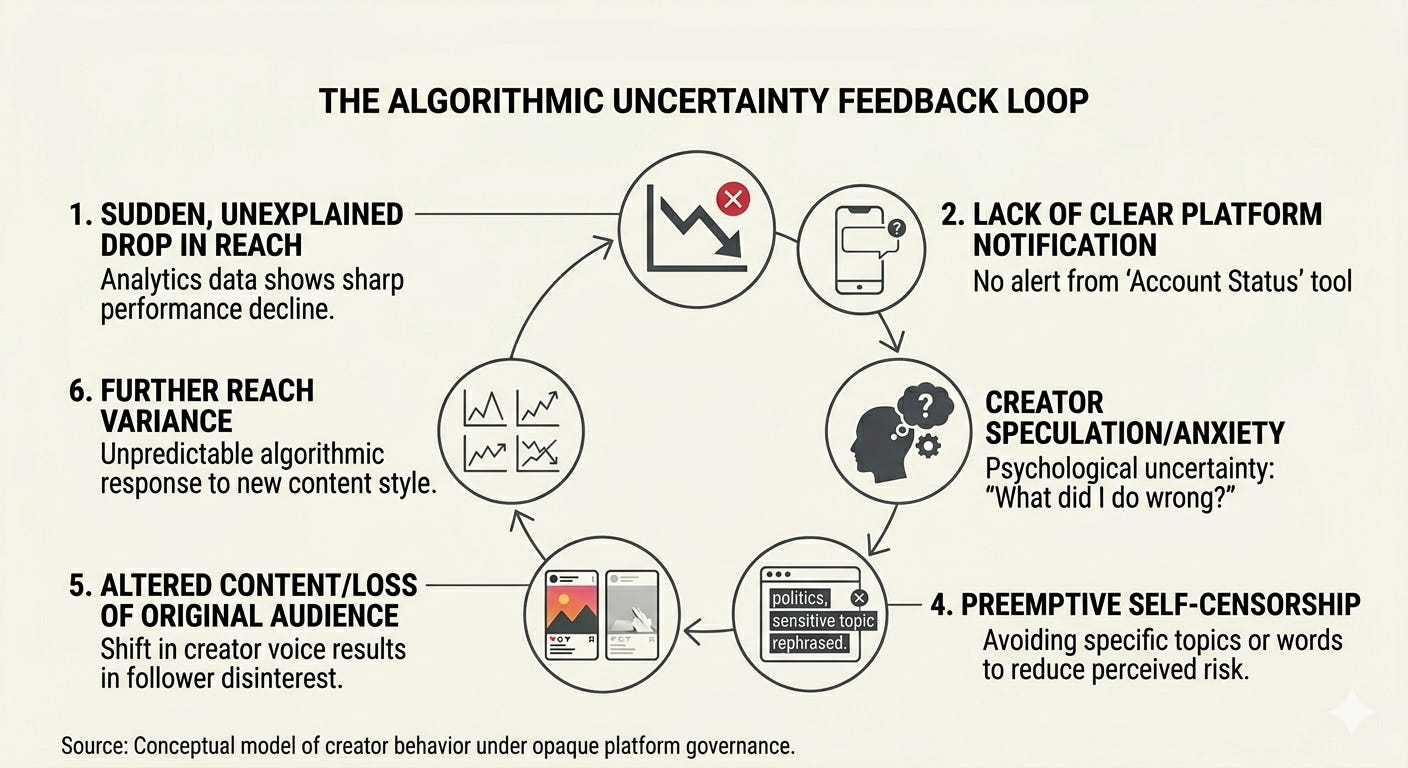
The problem for creators is that the line between normal performance variance and active restriction is invisible. No notification says “your content was deprioritized.” No log shows when recommendation eligibility was altered. There is no reliable test that distinguishes suppression from underperformance.
That invisibility is the core structural problem.
Why Unclear Moderation Rules Lead to Creator Self-Censorship
When the rules are unclear, people do not ignore them. They over-apply them.
A creator who suspects that discussing Palestine reduced their reach does not need confirmation to change behavior. Suspicion is sufficient. The cost of guessing wrong is real: a post that triggers restriction could damage a month’s worth of momentum, break a brand deal, or accelerate follower churn.
[Research published in New Media and Society by the SAGE platform governance study] found that creators, particularly those discussing socially contested topics, regularly self-censor as a direct response to algorithmic uncertainty. This is not an anecdote. It is a documented behavioral pattern.
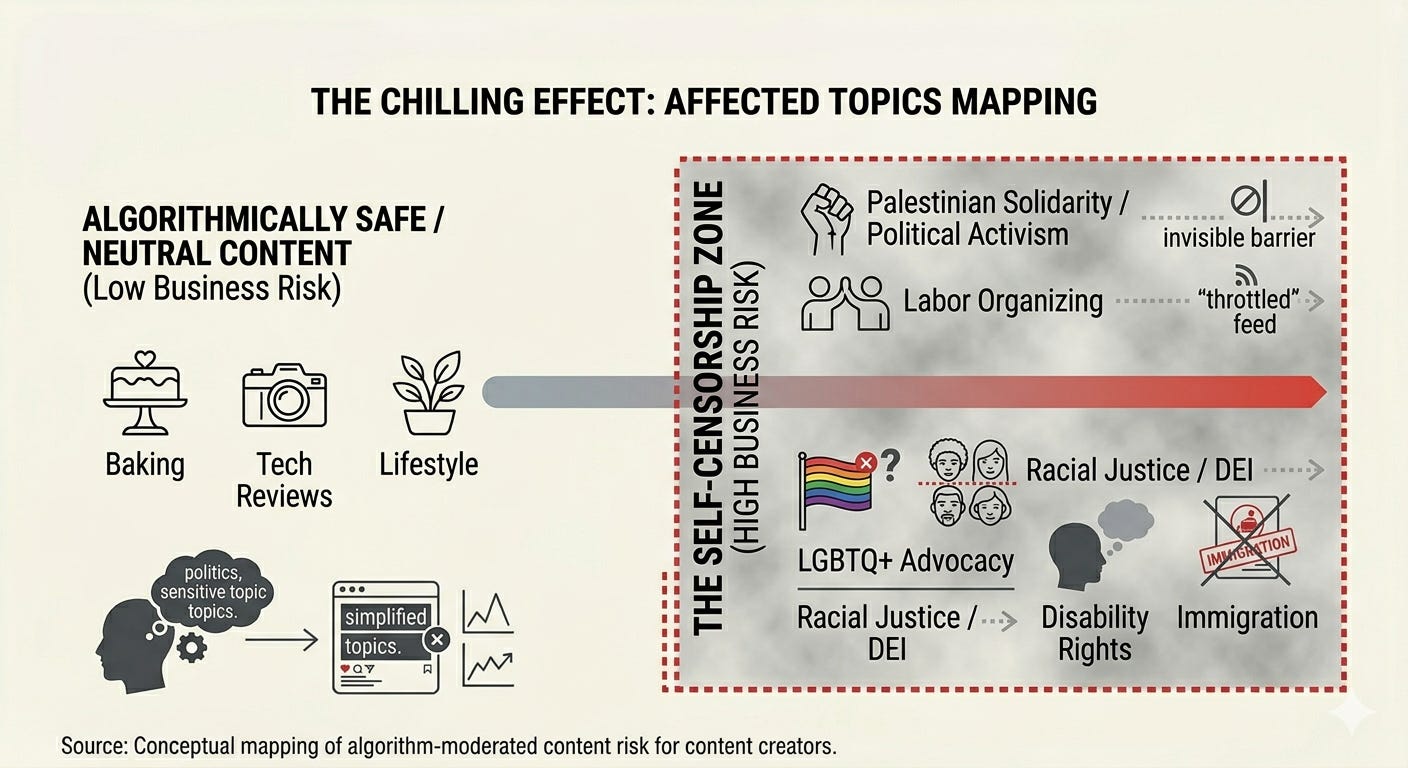
Creators in that research described avoiding words they believed would trigger suppression, softening language on sensitive topics, and avoiding certain subjects altogether. Not because the content was removed. Because uncertainty makes risk calculation impossible.
Gemini AI Image
The topics most commonly affected follow a clear pattern: politics, racial justice, Palestinian solidarity, labor organizing, LGBTQ+ advocacy, disability rights, and immigration. These are subjects where moderation lines are genuinely contested and where enforcement has historically been inconsistent.
Creators who depend on these topics for their professional identity face a compounding problem. The risk is not just a single suppressed post. The risk is that sustained discussion of certain subjects could permanently alter their algorithmic standing.
If creator income depends on visibility, uncertainty becomes behavioral pressure.
The result is a de facto restriction that does not require any explicit policy. The platform never has to say the content is unwelcome. Enough uncertainty produces the same result.
How Meta Moderation Becomes an Economic Issue for Creators
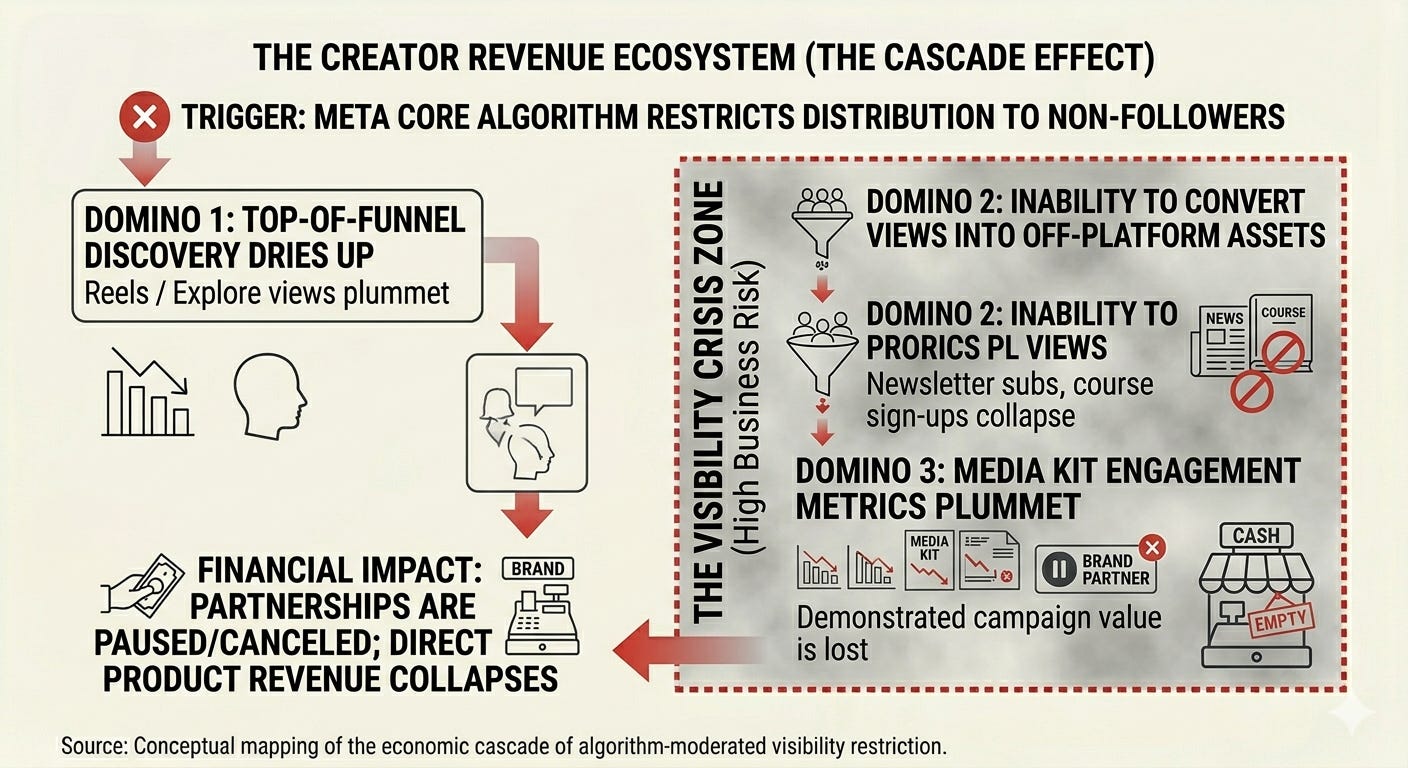
Gemini AI Image
For creators, visibility is not vanity. It is infrastructure.
An Instagram following is not just an audience. It is a distribution channel, a sales pipeline, a proof of reach for brand deals, a lead generation system for courses or consulting, and a subscriber funnel for newsletters, podcasts, or memberships. Every one of those revenue streams depends on the platform delivering content to the right people.
When the reach drops unexpectedly, the economic consequences cascade quickly. A creator whose Reels stop reaching new audiences loses their primary discovery channel. Reduced reach can affect their ability to demonstrate campaign value to sponsors, close affiliate commissions, convert followers to email subscribers, and generate direct product sales.
The Meta Transparency Center outlines how content is distributed and restricted, but it does not give creators real-time data about their own distribution status. Instagram Account Status surfaces some restriction information, but not the full picture of algorithmic treatment.
Brands and agencies know this. They monitor engagement rates closely. An unexplained engagement decline, even a temporary one, can cause a brand to pass on a creator, renegotiate rates downward, or terminate a partnership. The creator may never know whether the decline triggered that decision.
If distribution is your paycheck, unexplained distribution changes stop being a technical problem. They become a financial emergency with no clear cause and no clear recourse. Meta’s transparency resources describe the systems in general terms, but general terms do not help a creator figure out why their November looked nothing like their October.
This is why creators treat algorithmic uncertainty differently from other business risks. Most business risks have some traceable cause and some available response. Algorithmic uncertainty has neither.
Is Meta Intentionally Suppressing Political Content?
Gemini AI Image
This is the question most creators want answered. It deserves a careful response.
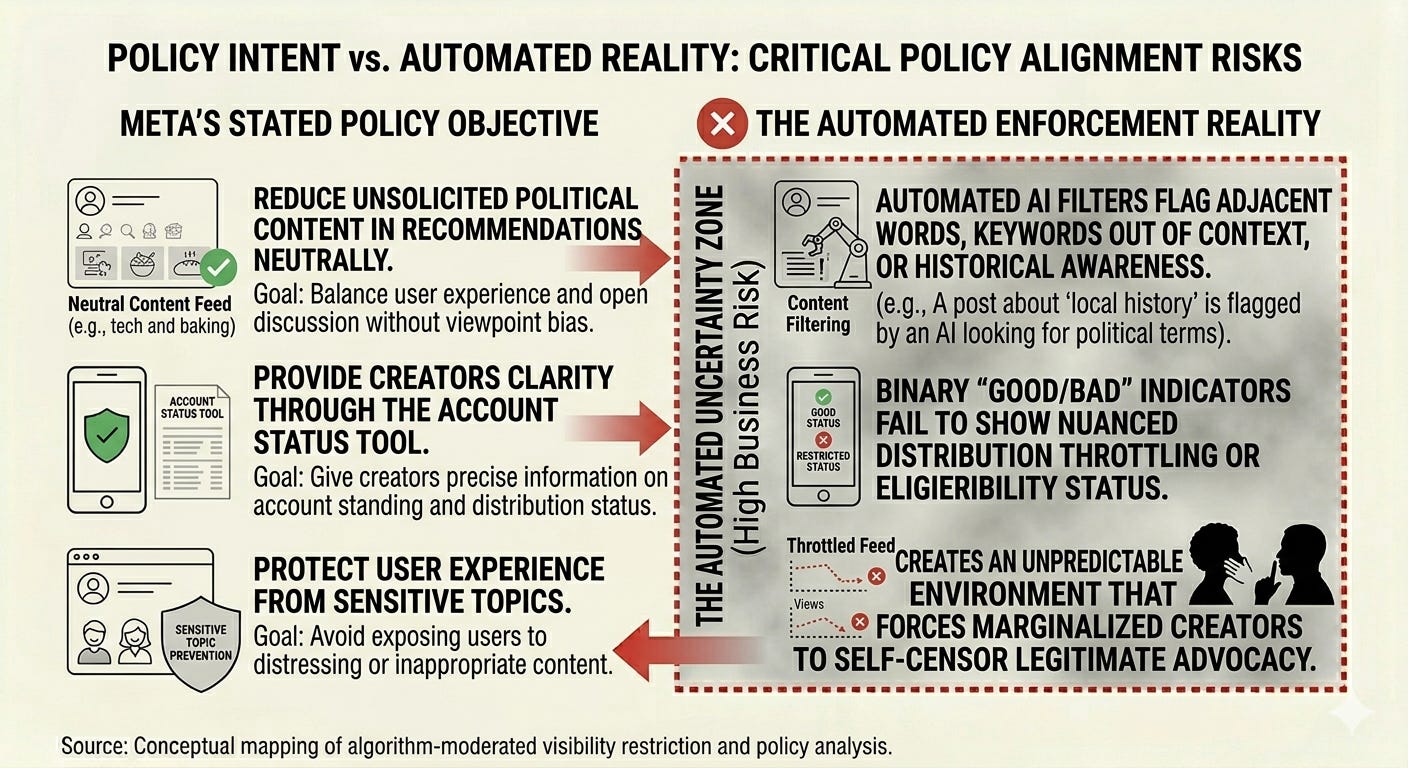
Meta has documented moderation systems. The Meta Transparency Center publishes information about content policies, removal rates, and enforcement mechanisms. These systems are real and extensive.
Recommendation eligibility rules exist that explicitly limit the distribution of certain content categories, including content that is “sensitive” by Meta’s definition. Political content falls into a category that Meta has actively sought to limit in recommendation surfaces across Instagram, Facebook, and Threads.
Meta stated publicly in 2023 that it would reduce the unsolicited distribution of political content in recommendations. That is a documented policy choice, not a conspiracy theory. It applies broadly, not to specific viewpoints.
Enforcement can be automated. Instagram Account Status reflects some of these automated decisions, but the systems behind them are not fully transparent. Policy complexity creates confusion that is itself a governance problem. When policies are broad, enforcement is automated, and appeals are opaque, creators cannot distinguish between intentional suppression and incidental policy application.
What the available evidence supports: Meta has policies that reduce the distribution of political and sensitive content. Those policies are applied by automated systems. Enforcement is inconsistent. Creators who discuss contested topics experience more unexplained reach variation.
What the available evidence does not support: a coordinated, intentional effort to suppress specific creators or specific viewpoints based on their politics.
The distinction matters. The problem is real without requiring intentional censorship. Opaque systems with broad policies and automated enforcement produce unpredictable outcomes. Those outcomes affect real creators with real businesses. That is the problem worth solving.
FAQ
Does Instagram shadowban creators?
Instagram does not use the term “shadowban,” but it does have documented systems that reduce content visibility without direct creator notification. Recommendation eligibility rules can remove content from Explore, hashtag feeds, and Reels recommendations. Creators may experience significant reach drops without receiving a clear explanation. Instagram’s Account Status tool provides some information about account restrictions, but does not give full visibility into algorithmic treatment.
Why are creators self-censoring on social media?
Creators self-censor primarily because of uncertainty, not confirmed suppression. When the rules governing visibility are unclear, and the consequences of triggering moderation are economically significant, creators avoid content they believe carries risk. Research published through SAGE on platform governance at the margins found that creators discussing politically or socially sensitive topics regularly alter their content to avoid perceived algorithmic penalties, even without confirmed evidence of suppression.
Does political content reduce Instagram reach?
Meta has publicly stated that it limits the recommendation of political content across Instagram, Facebook, and Threads. This is a documented policy, not speculation. Content discussing politics may be less likely to appear in Explore, Reels recommendations, and suggested accounts. Recommendation eligibility guidelines define what content qualifies for broad distribution. Whether this constitutes politically motivated censorship or a general sensitivity policy is contested.
What is Instagram recommendation eligibility?
Recommendation eligibility is Instagram’s system for determining whether a piece of content qualifies to appear in algorithmically driven surfaces like Explore, Reels, and suggested accounts. Content that violates community guidelines, or that falls into categories Instagram defines as sensitive, may be excluded from recommendations. This limits discoverability without removing the content entirely. Creators whose content is regularly deprioritized in these surfaces will see reduced reach from non-followers.
How do creators check Instagram account status?
Creators can check for account-level restrictions using Instagram’s Account Status tool, accessible through the app’s Settings menu under “Account.” The tool shows whether an account has any active violations or restrictions affecting distribution. However, it does not provide full transparency into algorithmic treatment, and many creators report that their account shows no issues even when they are experiencing significant reach declines.
The Governance Problem Behind the Creator Problem
Opaque systems do not have to be malicious to cause harm.
A system that automatically enforces broad policies across millions of accounts, provides limited feedback when enforcement occurs, and offers no meaningful appeal process, produces real harm regardless of intent. Creators are not paranoid for noticing that. They are responding rationally to an environment that gives them almost no reliable information.
The solution is not for creators to post more carefully or worry less. The solution is transparency: clear policies, legible enforcement, meaningful appeals, and real-time visibility into how content is being distributed and why.
Until that exists, creators will continue to make decisions based on uncertainty. Some will self-censor. Some will leave platforms. Some will diversify aggressively to reduce platform dependency. All of them will spend cognitive and financial resources managing a risk that better governance could eliminate.
That is the cost of opacity. Not to the platform, which absorbs it invisibly. To the creators who built their businesses on it.
Gregory H. Bourne has spent years translating AI from Silicon Valley mythology into practical systems for people the tech world wasn't talking to. A published author of fiction and nonfiction and a working AI consultant, he writes specifically for Black solopreneurs and midlife founders - the ones who were told this revolution belongs to someone younger.
Thanks for Reading
Buy Me A Coffee |Gumroad| Medium