
The Death of Busywork Is Creating a Judgment Economy
AI is changing what work is worth. As routine execution becomes cheaper, human judgment becomes the skill businesses value most


Photo by José Martín Ramírez Carrasco on Unsplash
Editor's Note: This essay introduces a framework I have been developing to explain how AI changes the economics of work. Future essays will expand on Judgment Governance, the AI Department Framework, the Ownership Gap, and the Decision Dividend. This article lays the foundation.
For decades, work rewarded people who completed more tasks. Answer more emails. Close more tickets. Produce more slides. Execution was the job.
We built careers around execution because execution was scarce.
AI changes that equation. Today, the scarce resource is no longer execution. It is judgment.
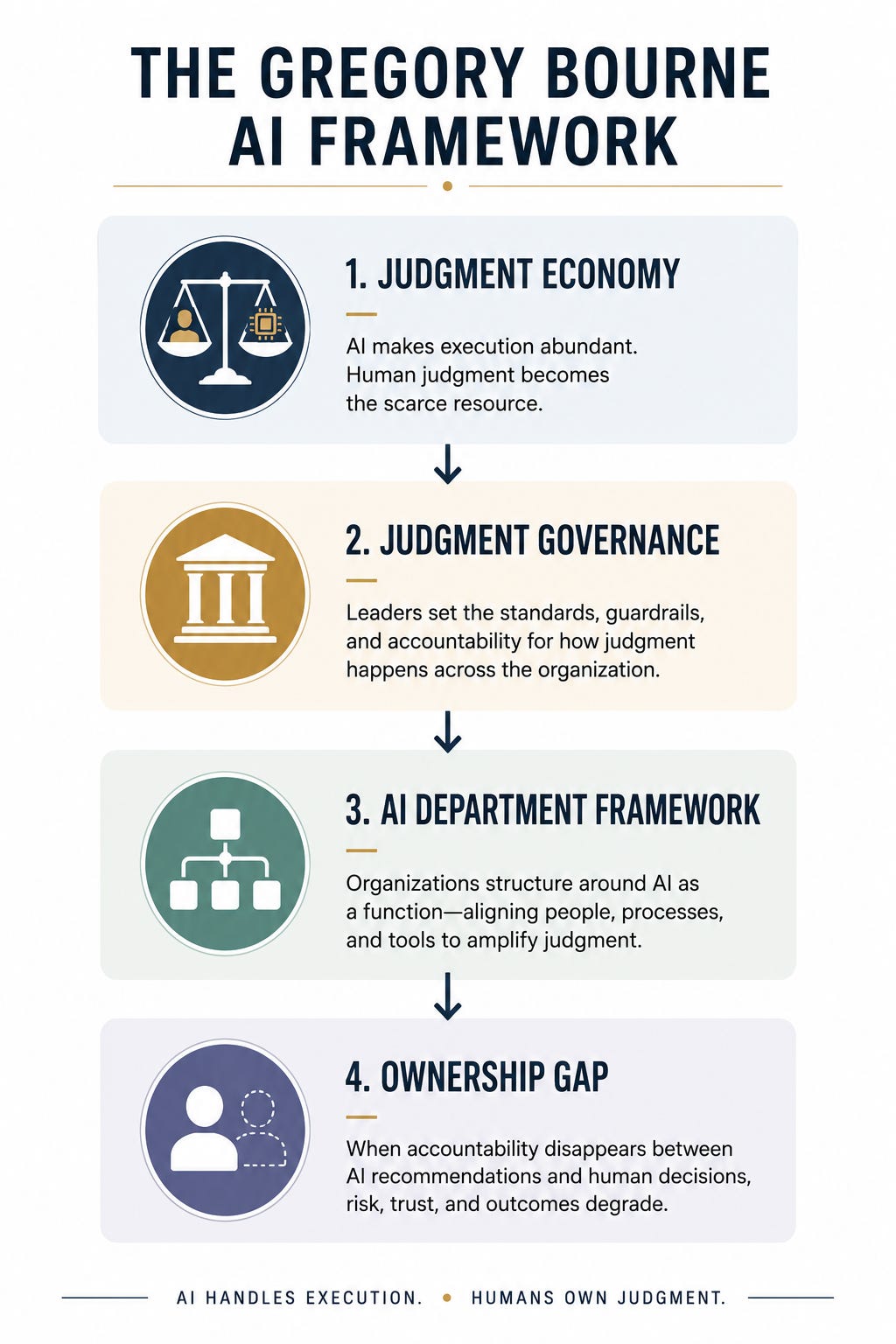
The Judgment Economy explains this economic shift. Judgment Governance explains how leaders manage it inside an organization. The AI Department Framework explains how businesses structure themselves around it. The Ownership Gap explains what happens when accountability quietly disappears in the space between an AI recommendation and a human decision. Four ideas, one shift, viewed from four different altitudes. Each framework answers a different question. Together, they explain why AI changes economic value, leadership, organizational design, and accountability.
**Key Takeaways**
- AI reduces the value of routine execution.
- Judgment becomes a scarce resource.
- Better decisions become the competitive advantage.
- Organizations compete on decision quality, not output volume.
- Founders should automate execution, not judgment.
```
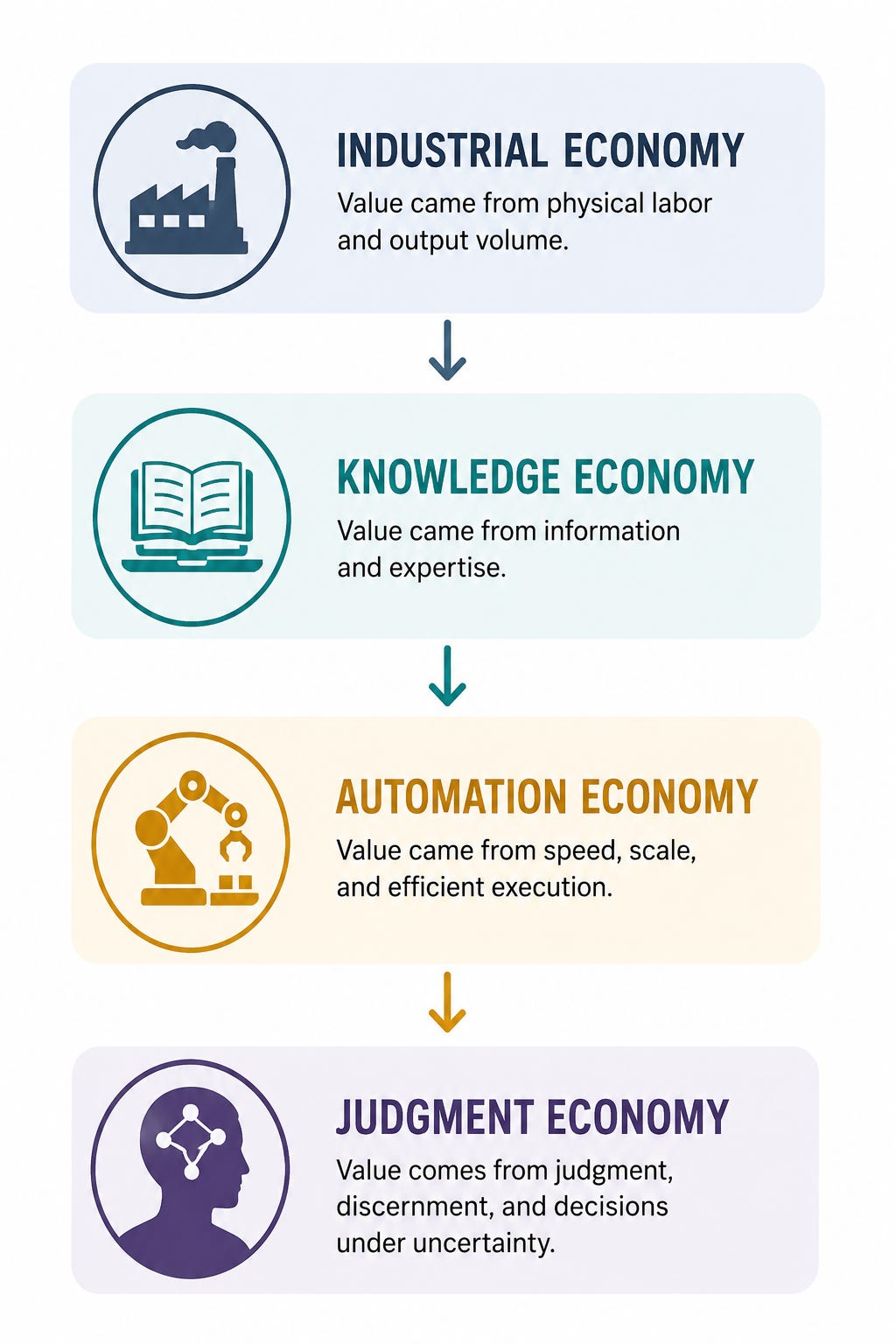
The Evolution of Economic Value
```
What Is the Judgment Economy?
The Judgment Economy is the economic shift in which AI absorbs an increasing share of routine execution, and human value concentrates in judgment: interpretation, ethical reasoning, strategic thinking, and decision making under uncertainty. It emerged because generative AI reached a threshold where it could reliably produce drafts, research, analysis, and code at a cost and speed no human team can match, which broke the old link between effort and value. The Knowledge Economy rewarded people for possessing and retrieving information, a scarcity created by limited access to training, credentials, and data. AI ended that scarcity. What it cannot do is decide what the information means, weigh competing tradeoffs with incomplete data, or accept the consequences of a decision made without a guaranteed right answer. That matters to businesses because, as execution becomes abundant and commoditized, judgment becomes the one input competitors cannot copy, automate, or outsource at scale.
Existing discussions about AI focus on productivity. This framework focuses on value. I use the term Judgment Economy to describe this shift because the productivity frameworks explain how AI changes technology, not how AI changes what a decision is worth.
Here is what that means in practice.
- AI drafts the first version. You decide if it is right.
- AI processes the data. You decide what it means.
- AI generates options. You decide which one to bet the business on.
That last decision is the one that still requires a person. It always will.
Every Economy Rewards a different scarce resource
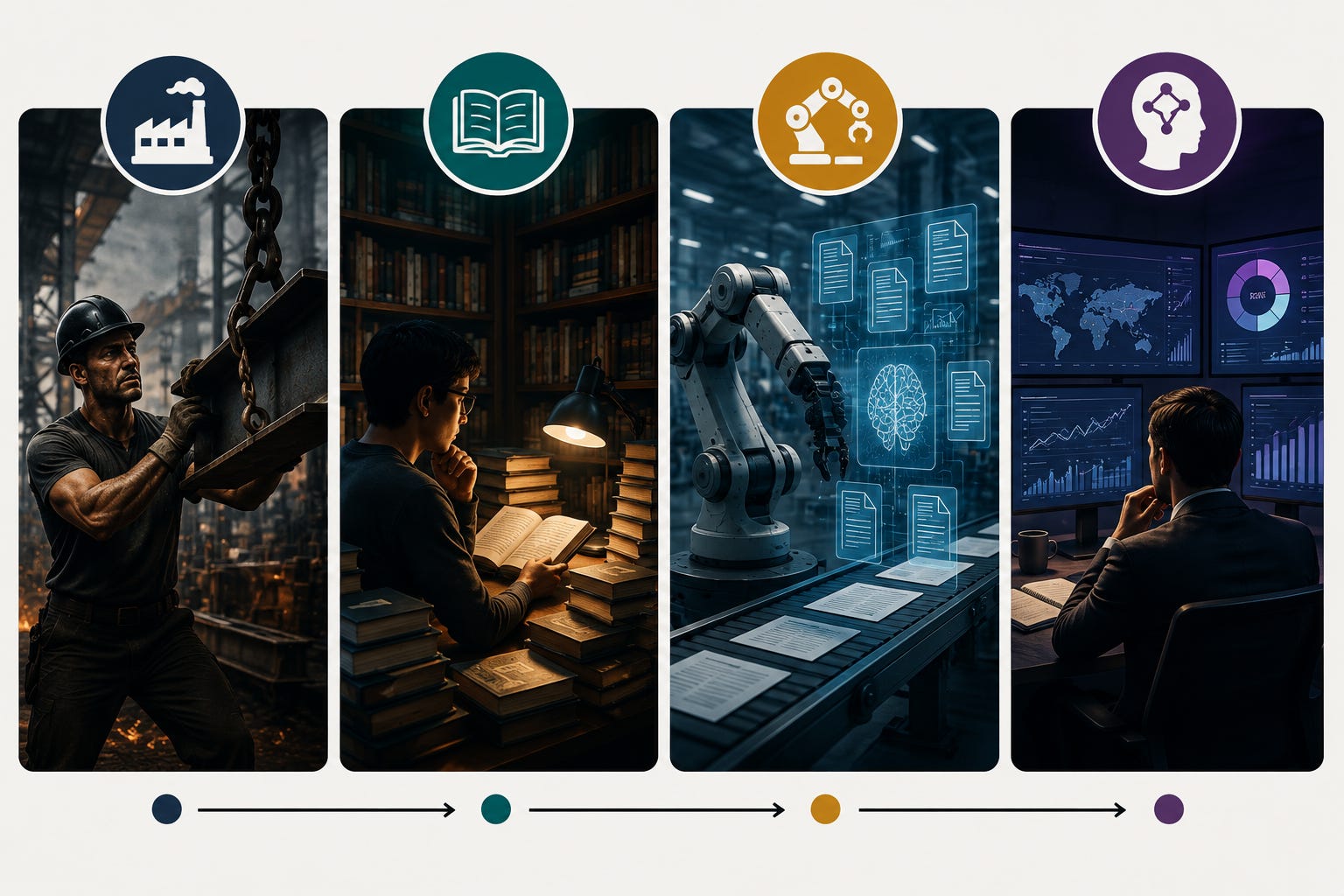
Every economic era pays for whatever is scarce in that era, and the resource always changes as technology catches up to the last one.
The Industrial Economy rewarded physical strength and output volume because machines could not yet replace human labor. The Knowledge Economy rewarded information and expertise because access to knowledge itself was limited to those with training or credentials. The internet and search ended that scarcity. Then generative AI ended the scarcity of *producing* knowledge work: drafts, summaries, code, research, and first-pass analysis.
That leaves the Judgment Economy. Execution is now abundant. Information is now abundant. What remains scarce is the ability to take abundant execution and abundant information and turn them into a decision someone is willing to stand behind. That is not a new skill. It is the oldest skill in business. Technology has just made it the only one that is still hard to buy.
Why Is Busywork Disappearing?
is disappearing because AI performs repetitive, rules-based tasks faster and at lower cost than people. Human work increasingly centers on judgment, interpretation, oversight, and decisions under uncertainty.
McKinsey’s 2025 research on skill partnerships in the age of AI found that more than half of current US work hours could theoretically be automated with today’s technology. That is not a job forecast. It is a measure of how much of the modern workday is still built on tasks with a clear, learnable procedure. The same research estimates roughly $2.9 trillion in US economic value could be unlocked by 2030, but only for organizations that redesign entire workflows around people, AI agents, and automation together, rather than automating isolated tasks.
The Economic Forum’s Future of Jobs Report 2025 provides a number on the churn this creates. By 2030, 170 million new jobs will be created, and 92 million will be displaced globally, a structural shift touching 22 percent of the world’s formal jobs. Nearly 40 percent of core job skills are expected to change within five years.
The OECD found something specific about which skills rise as AI exposure rises. In the occupations most exposed to AI, like programmers, budget analysts, and administrative assistants, demand shifts toward management, business, and human skills, while demand for narrow digital execution skills falls in those same roles. AI is not just removing tasks. It is reallocating what a job pays a person to know.
Routine work. Repetitive work. Documentation. Data entry. This is the layer AI absorbs first, because it is the layer with the clearest rules and the least ambiguity.
AI Doesn’t Make Judgment Valuable. Scarcity Does.
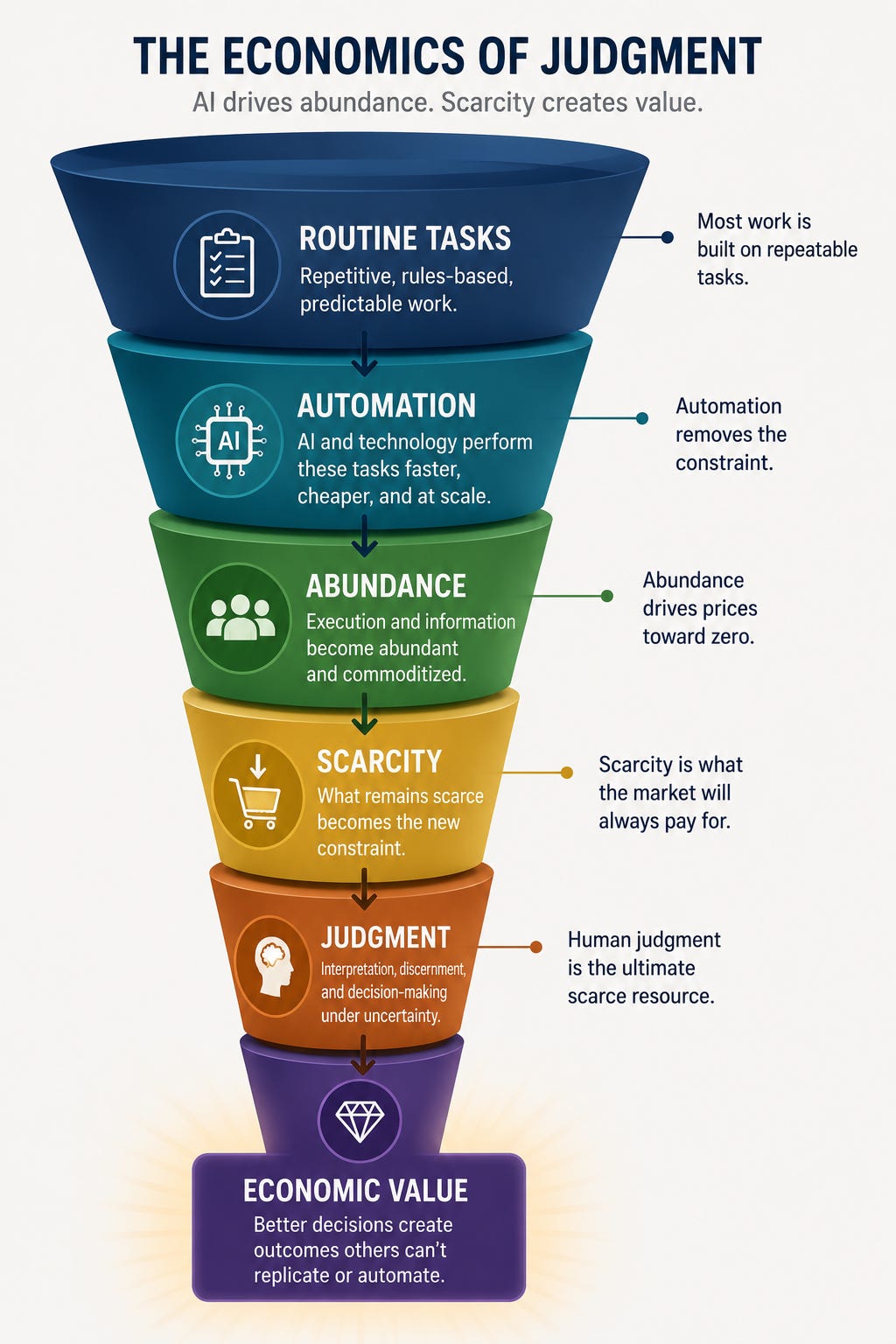
AI is not what makes judgment valuable. Scarcity is what makes judgment valuable, and AI is simply the mechanism creating that scarcity right now.
This distinction matters because most commentary on AI and work treats judgment as though it has just become important. It did not. Judgment was always the harder, rarer skill. It was simply masked by how much time and money organizations spent on the execution layer beneath it. Pay someone well enough to gather the research, format the report, and manage the process, and their judgment looks like one input among many. Automate the research, the formatting, and the process, and judgment stands alone as the only input left.
AI changes supply. Supply changes value. Every economics course teaches this in week one, and the AI era is the clearest live demonstration of it that most people will see in their working lives.
AI produces information. Judgment produces direction.
Why Judgment Becomes More Valuable
Execution becomes abundant. Judgment becomes scarce. Scarcity increases value. That progression is the central argument of this entire framework, and it holds regardless of industry, company size, or role. The cheapest work becomes invisible. The hardest decisions become priceless.
When a resource becomes cheap and widely available, it loses its competitive advantage. The advantage shifts to whoever can direct that resource toward the right outcome. AI writes the report. A person still has to decide whether the report’s conclusion should drive a six-figure decision. AI drafts the contract clause. A person still has to decide whether that clause protects the business or exposes it. AI flags the anomaly in the data. A person still has to decide whether the anomaly is noise or the early sign of a real problem.
McKinsey’s research on building the agentic organization makes the same point from inside the enterprise. As organizations hand more autonomous work to AI agents, governance becomes a core design decision, not an afterthought. Someone must define where human oversight and judgment are required before the workflow begins. Skip that step, and the organization has not eliminated risk. It has hidden it.
I have written before about why human oversight alone isn’t enough. Watching an AI system is not the same skill as judging its output. The Judgment Economy is what happens when that distinction becomes the whole game.
The Judgment Premium and the Decision Dividend
```
The Judgment Premium
Automation
↓
Execution
↓
Scarcity
↓
Judgment
↓
Economic Value
```
The Judgment Premium is the additional economic value produced by better human judgment after AI automates routine execution. I use this term because until AI stripped away the busywork surrounding these roles, that value was never priced on its own. It was bundled into the hours.
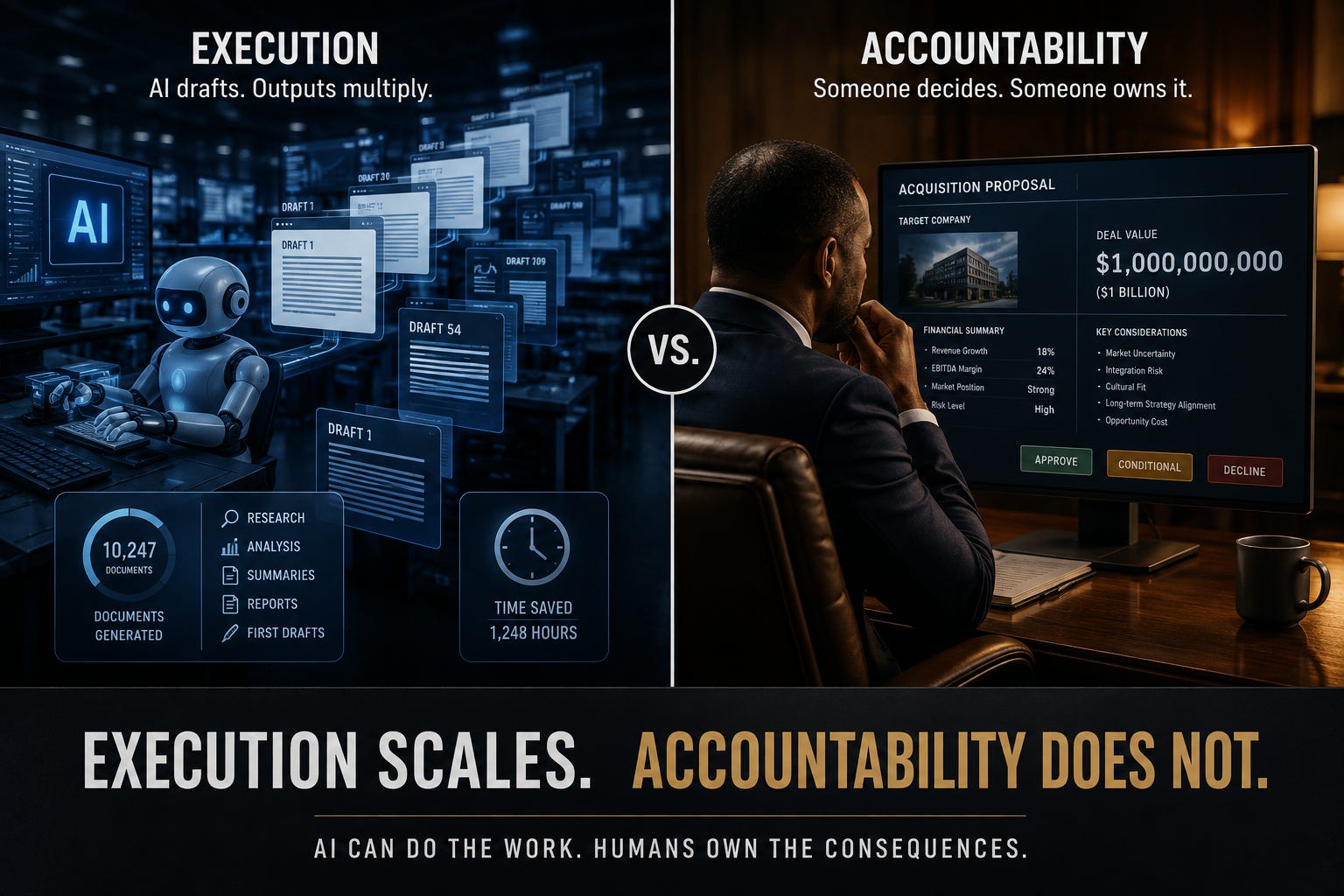
This is why lawyers, executives, consultants, editors, and founders continue to command premium compensation even as AI absorbs large parts of their fields. A lawyer’s value was never really the drafting. It was knowing which clause protects the client in a dispute that has not happened yet. A consultant’s value was never really the research deck. It was recommending the one move worth the risk. AI can now produce the draft and the deck faster than any junior hire. It cannot own what happens if the recommendation is wrong. That ownership, and the judgment behind it, is what the premium pays for.
The Judgment Premium explains the value of a single high-quality decision. Over time, repeated good decisions compound into what I call the Decision Dividend, the long-term value created when consistently better decisions stack quarter after quarter into trust, referrals, and reduced risk. The Decision Dividend deserves its own discussion because sustained decision quality compounds over years, not weeks. I will explore it fully in a future article.
The New Skill Stack
AI is not eliminating skills. It is repricing them. Some skills that built careers for twenty years are losing value fast. Others are gaining value just as fast.
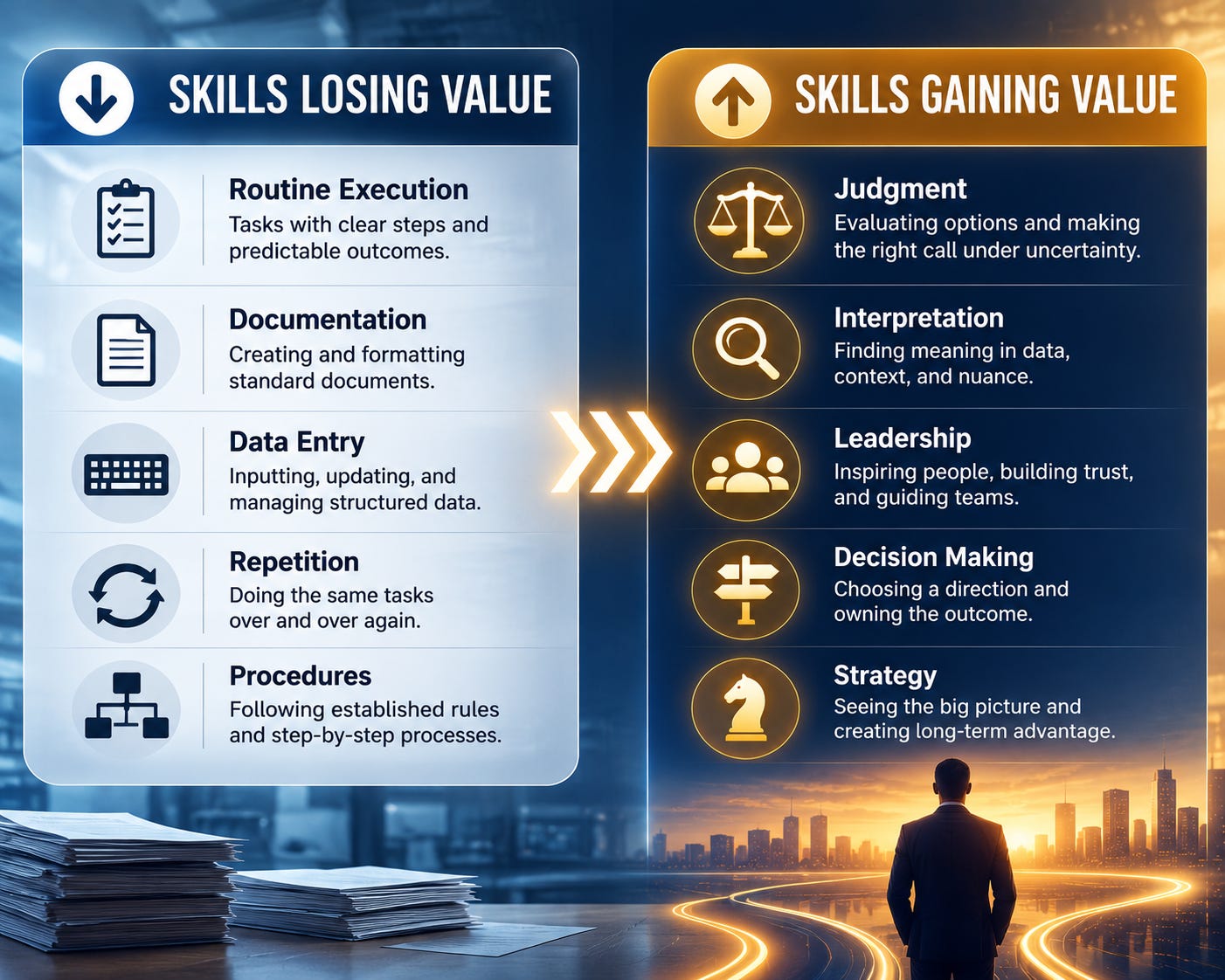
The OECD’s Artificial Intelligence and the Future of Skills research builds its entire methodology around this same idea: understanding precisely what AI can and cannot do is the only reliable way to know which human skills remain complementary rather than redundant. The skills on the right side of the table above are the ones that research keeps identifying as durable.
The shift also shows up when you compare the Knowledge Economy directly to the Judgment Economy.
| Knowledge Economy | Judgment Economy |
|---|---|
| Information | Interpretation |
| Research | Decisions |
| Documentation | Context |
| Execution | Leadership |
| Speed | Discernment |
And it shows up again when you separate what AI is actually good at from what people are actually good at, without the hype on either side.
| AI Excels At | Humans Excel At |
|---|---|
| Speed | Judgment |
| Scale | Context |
| Pattern matching | Trade-offs |
| Drafting | Accountability |
| Consistency | Leadership |
Notice the pattern across all three tables. Every skill on the losing or AI side can be specified in advance. Every skill on the gaining or human side requires context that changes on a case-by-case basis. That is the real dividing line, not “technical versus creative” and not “junior versus senior.”
**A quick example.** A founder used to hire an assistant to research competitors: pull pricing pages, summarize positioning, and log feature gaps into a spreadsheet. Today, AI does that research in minutes. The founder’s job did not disappear. It moved. The founder no longer spends time collecting information. The founder spends time deciding what deserves attention. Their value now sits entirely in what they do with the research: which competitor to worry about, which gap is worth building for, and which finding is a distraction dressed up as an insight. The task got automated. The judgment about the task did not, and never will.
Who Benefits Most from the Judgment Economy?
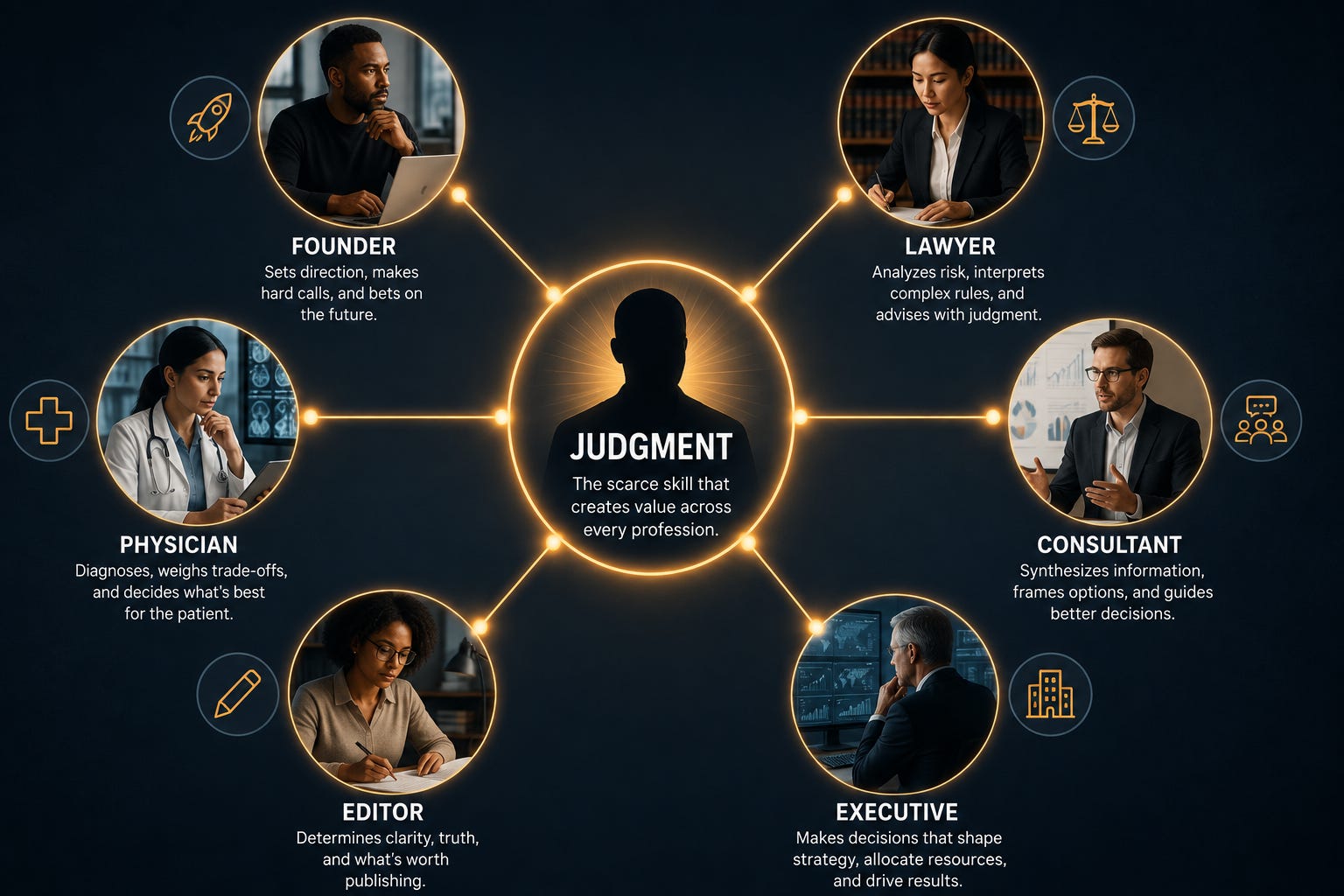
I have spent the past year studying how founders integrate AI into daily decision-making, and one pattern shows up again and again: the people who benefit most are not the ones who adopt AI fastest. They are the ones who already got paid for judgment before AI existed, and now have more time to exercise it.
**Founders** benefit because AI clears the operational busywork that used to eat up the hours they should be spending on strategy, hiring, and positioning.
**Consultants** benefit because clients were always paying for the recommendation, not the deck. AI shortens the path to the recommendation.
**Lawyers** benefit because contract review and case research accelerate, while the judgment about risk, exposure, and strategy stays entirely human.
**Physicians** benefit because AI can surface patterns in data and literature faster than any person, but the decision about a specific patient’s care still requires a licensed, accountable human.
**Editors** benefit because AI can generate drafts endlessly, which makes the editor’s taste, judgment about what is worth publishing, and understanding of an audience more valuable, not less.
**Executives** benefit because AI can model scenarios and summarize options at a scale no team of analysts could match, but the choice among those options, and the responsibility for it, remains the executive’s job.
The common thread: every one of these roles already lived on judgment. AI just removed the busywork that used to disguise how much of the job was judgment all along. The future belongs to organizations that know which decisions never leave human hands.
Five Signs You’re Already Working in the Judgment Economy
You do not need a title change to already be operating in this economy. Look for these signals.
1. AI writes your first drafts, and you spend more time reviewing than composing.
2. Clients and employers pay you for advice more than for output.
3. Context matters more to your work than raw speed.
4. Relationships and trust matter more than repetition and volume.
5. Your value shows up in the decisions you approve, not the tasks you complete.
If three or more of these describe your week, the shift is not coming. It already happened.
What Founders Should Do Next
Most founders respond to AI by asking, “What can I automate?” That is the wrong first question. The right first question is, “Which decisions in this business actually require a human, and am I protecting the time it takes to make them well?” Every automation project is really a judgment allocation project.
I have argued before that most solopreneurs are using AI backwards. They automate the parts of the business that already differentiate them and leave the truly routine work untouched, because the routine work feels safer to leave alone. My upcoming AI Department Framework goes deeper into how to structure a business around this principle before you hire your first employee.
Here is a simple framework to reverse the mistake. Call it JUDGE.
**Judge** which decisions in your business actually require human accountability.
**Understand** what AI can and cannot see in the data you feed it.
**Delegate** the routine execution fully, without hovering over it.
**Govern** the process with clear checkpoints for review before consequences land.
**Evaluate** the outcome and adjust the system, not just the individual output.
Run your business through those five steps once, and you will find tasks you are still doing that AI should own, and decisions AI is quietly making that you should own instead.
Before we finish, let’s define the vocabulary behind this framework.
Glossary
**Busywork** — Repetitive, rules-based work that follows a clear, learnable procedure and requires no judgment to complete correctly.
**Judgment** — The ability to make a good decision under uncertainty, without a guaranteed right answer, and to accept accountability for the outcome.
**Execution** — The act of carrying out a defined task once the decision about what to do has already been made.
**Knowledge Work** — Work whose primary value comes from possessing, retrieving, or applying specialized information.
**Decision Making** — The process of choosing among competing options when the outcome is uncertain, and the stakes are real.
**Judgment Governance** — The leadership discipline of defining who owns which decisions, where AI output requires human review, and how accountability survives contact with automation.
**AI Department Framework** — A structural approach to organizing a business’s functions around AI-first execution, with human judgment placed deliberately at the decision points that matter most. *(Link to come once this companion article is published.)*
**AI Agent** — A system built on generative AI that can act, plan, and execute multistep tasks with limited human input.
How These Ideas Fit Together
```
```
The Judgment Economy explains the shift at the level of the whole economy. Judgment Governance explains how a leader puts that shift into practice inside a single organization. The AI Department Framework explains how a founder structures a business around it from day one. The Ownership Gap explains what happens when accountability quietly disappears in the space between an AI recommendation and a human sign-off. Each one answers a different question. Together, they describe the same underlying shift from four different altitudes: the economy, the leader, the organization, and the decision itself.
Frequently Asked Questions
**What is the Judgment Economy?**
It is the economic shift where AI absorbs routine execution and human value concentrates in judgment, interpretation, and decision-making under uncertainty. As execution becomes abundant and cheap, the ability to decide well becomes a scarce and valuable skill.
**What is busywork?**
Busywork is repetitive, rules-based work with a clear procedure and no real ambiguity, such as data entry, formatting, or routine documentation. It is the layer of work AI automates first because it requires the least judgment to complete.
**Why is AI reducing busywork?**
Because AI can perform repetitive, rules-based tasks faster and more cheaply than people, and it does not get tired, distracted, or inconsistent doing them.
**Why is judgment becoming more valuable?**
Because execution and information are becoming abundant, scarcity is what determines economic value. As the supply of routine execution goes up, the price of the skills required to direct it goes up, too.
**Is the Judgment Economy replacing the Knowledge Economy?**
It is building on top of it, not erasing it. Knowledge and information still matter, but they are no longer scarce enough on their own to command a premium. The Judgment Economy is what happens after the Knowledge Economy’s core resource, information, stops being rare.
**What industries will be affected first?**
Industries built on high volumes of research, documentation, and routine analysis, such as law, consulting, financial services, and content production, are already seeing the shift. Any field where the output used to take a person hours to produce, but the underlying decision took minutes, will feel it early.
**How do AI agents fit into the Judgment Economy?**
AI agents are the mechanism that absorbs execution at scale. They plan and carry out multistep tasks with limited human input, which is exactly what accelerates the shift toward judgment as the scarce resource. The more autonomous the agent, the more important it becomes to decide upfront where human judgment still has to sit in the workflow.
**What is the Judgment Premium?**
The Judgment Premium is the additional economic value produced by better human judgment after AI has already automated the routine execution around it. It explains why roles built on decision-making keep commanding premium pay even as AI absorbs the tasks that used to support those roles.
**Will AI replace all jobs?**
No. The World Economic Forum projects a net gain of 78 million jobs globally by 2030, even as 92 million are displaced. The jobs disappearing are concentrated in routine, rules-based work. The jobs growing require judgment, oversight, and adaptability.
**Will AI replace managers?**
Not the parts of management that involve judgment. AI can absorb scheduling, reporting, and status tracking. It cannot absorb the decisions about who to trust with a project, how to handle an underperforming team member, or which tradeoff a team should accept. Those decisions are the actual job.
**Which skills matter most in the AI era?**
Interpretation, decision making, strategic thinking, and the ability to evaluate AI output for accuracy and risk. Research from the OECD shows management, business, and human skills rising in demand, specifically in the roles most exposed to AI.
**What work still requires people?**
Any decision with real consequences and real ambiguity. AI can generate options and surface patterns. A person still has to weigh tradeoffs, accept accountability, and decide what the organization is willing to risk.
**How should founders prepare for the Judgment Economy?**
Start by identifying which decisions in the business actually require a human, then automate everything else without hesitation. The JUDGE framework above walks through this directly: judge, understand, delegate, govern, evaluate.
**How does Judgment Governance fit into the Judgment Economy?**
Judgment Governance is the leadership discipline that puts the Judgment Economy into practice inside an organization. It defines who owns which decisions, where AI output needs review, and how accountability survives contact with automation. One is the economic shift. The other is how you lead through it.
Where This Goes Next
The Industrial Economy rewarded strength. The Knowledge Economy rewarded information. The Judgment Economy rewards discernment.
Execution becomes abundant. Judgment becomes scarce. AI scales execution. People scale judgment. Automation lowers the price of routine work, and judgment raises the value of everything left.
AI answers questions. Leaders accept consequences. Every improvement in AI raises the return on better decisions, because every improvement in AI hands more of the routine work to a system that will never be the one held accountable for what it produces.
Technology did not invent judgment. It revealed its value by finally stripping away everything that used to hide it.
The organizations that thrive in the next decade won’t simply automate more work. They’ll build better judgment.
Execution used to be the job. Judgment is becoming the business.
Read Next
What Is Judgment Governance?
Human-in-the-Loop Isn’t Enough
Most Solopreneurs Are Using AI Backwards
The Ownership Gap in AI
Before You Hire Your First Employee, Build an AI Team (coming soon)
This is the first essay in an ongoing series exploring how AI is changing work, leadership, and organizational design. Future essays will expand on Judgment Governance, the AI Department Framework, the Ownership Gap, and the Decision Dividend.
Thanks for Reading
Buy Me A Coffee |Gumroad| Medium
Gregory Bourne writes at the intersection of analog life and digital power, crafting frameworks for people who weren’t supposed to be part of the tech conversation. A published author and AI consultant, he helps Black solopreneurs and midlife founders build robust digital systems without compromising human judgment.
👉 Learn more and get the frameworks at feralgeneration.substack.com.