


Photo by Sahand Babali on Unsplash
Episode #108
These two terms are frequently confused, conflated, and misused. They are not the same thing. One is a political ideology. The other is a form of hatred.
Understanding the difference matters.
What Is Zionism?
Zionism is a political movement that emerged in the late 19th century. Its central goal was the establishment of a Jewish homeland, which was achieved with the founding of the State of Israel in 1948. Today, Zionism broadly refers to support for the existence and security of Israel as a Jewish state.
What Is Antisemitism?
Antisemitism is prejudice, discrimination, or hostility directed at Jewish people because they are Jewish. It has existed for centuries and reached its most extreme form in the Holocaust, during which the Nazi regime systematically murdered six million Jews. Antisemitism targets people based on their identity, not their politics.
What Is the Difference Between Zionism and Antisemitism?
Short answer: Zionism is a political position about a state. Antisemitism is prejudice against a people.
ZionismAntisemitismTypePolitical ideologyPrejudice / hatredTargetA state (Israel)A people (Jewish people)Can be held by Jews? Yes, Rarely, by definition, can be held by non-Jews?YesYesSubject to debate?YesNo — hatred is not a debate
Zionism is a political stance. You can agree or disagree with it.
Antisemitism is bigotry. It is not a political position - it is discrimination.
Is Anti-Zionism the Same as Antisemitism?
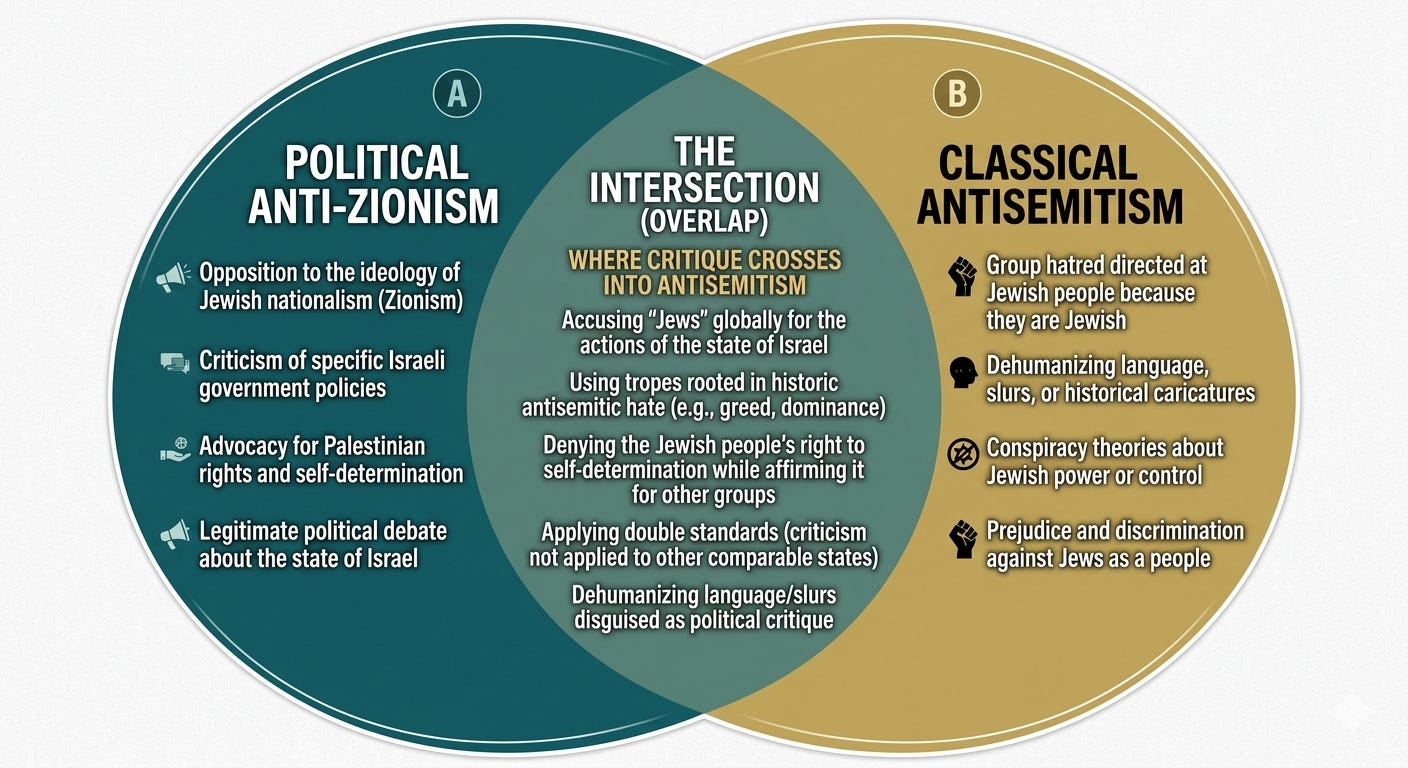
No. Anti-Zionism is opposition to Zionism as a political ideology or to specific Israeli government policies. Antisemitism is hatred toward Jewish people as a group. These are distinct categories. However, the two can overlap. When criticism of Israel slides into generalizations about Jewish people as a whole, or relies on antisemitic tropes, it crosses into antisemitism.
When Does Anti-Zionism Become Antisemitism?
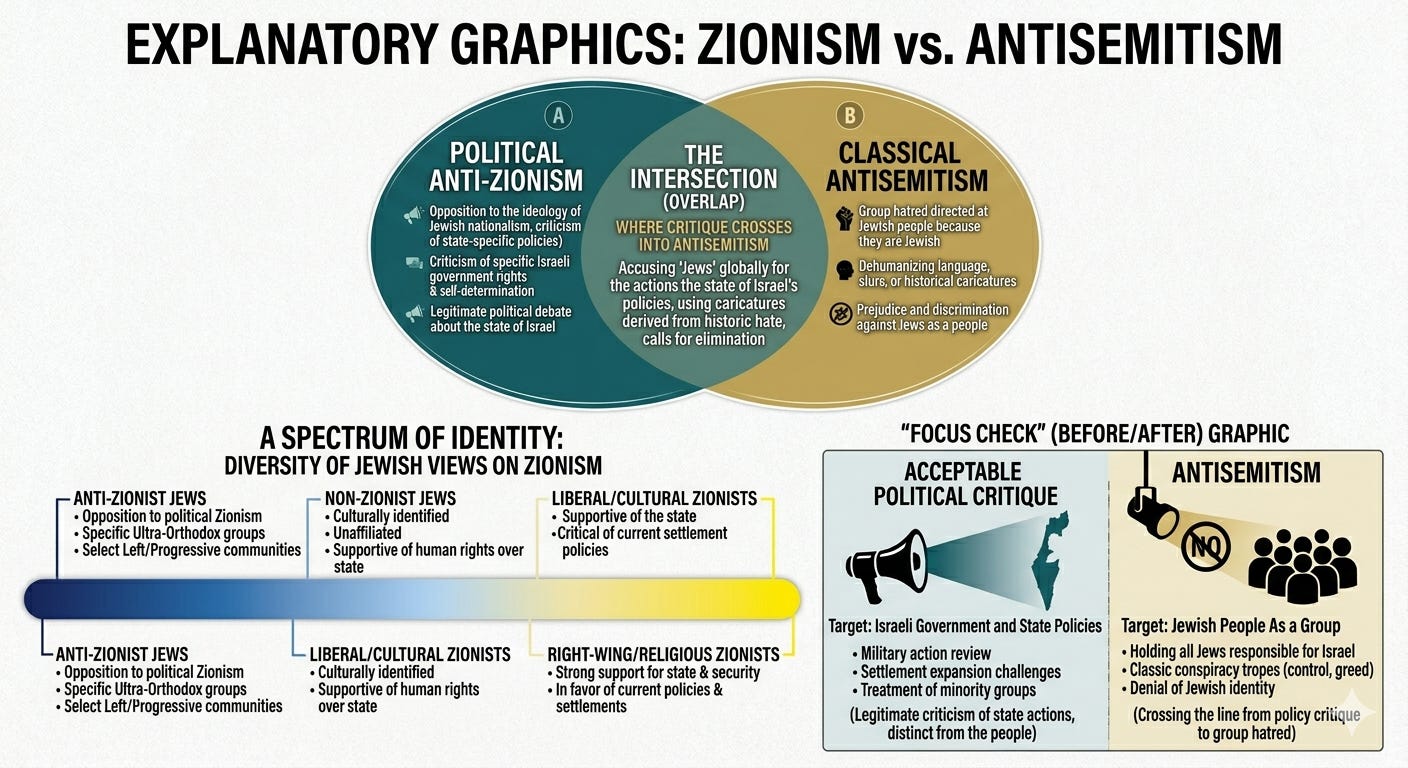
Criticism of Israel is not automatically antisemitic. But certain patterns cross the line. Anti-Zionism becomes antisemitism when it involves:
Collective blame - holding all Jewish people responsible for Israeli government actions
Dehumanizing language - using slurs, conspiracy theories, or imagery rooted in historic antisemitic hate
Double standards - applying scrutiny to Israel that is never applied to comparable states
Denial of Jewish identity - claiming Jewish people are not a real people or have no historical connection to the region
Stereotyping - framing criticism through tropes about Jewish power, greed, or control
Calls for elimination - advocating for the destruction of Israel, specifically because it is a Jewish state
The test is simple: is the criticism targeting a government and its policies, or is it targeting Jewish people as a people?
Can You Criticize Israel Without Being Antisemitic?
Gemini generated image
Yes. Criticism of Israeli government policy is legitimate political speech. Governments, including Israel’s, are not above scrutiny. Journalists, academics, human rights organizations, and foreign governments criticize Israeli policy regularly without engaging in antisemitism. The key distinction is focus:
Acceptable: Criticizing Israeli settlement policy, military actions, or treatment of Palestinians
Antisemitic: Framing those policies as evidence of an innate Jewish character, or blaming Jewish people globally for Israel’s decisions
Criticize the policy. Criticize the government. Do not transfer that criticism to Jewish people as a group.
Why Do People Confuse Zionism and Antisemitism?
Several factors drive the confusion:
Identity overlap - For many Jewish people, Israel is deeply tied to cultural and religious identity. Attacks on Israel can feel like attacks on Jewish people, even when they are not.
Political weaponization - Both terms are sometimes used strategically. “Antisemitism” is occasionally invoked to shut down legitimate criticism. “Anti-Zionism” is sometimes used as a cover for actual antisemitism.
Media framing - News coverage of the Israeli-Palestinian conflict often lacks clear language, blurring the line between political critique and group hatred.
Genuine overlap - Some anti-Zionist rhetoric does cross into antisemitism, which reinforces the association even when it does not apply.
Understanding these dynamics helps explain the confusion without excusing the conflation.
What Is the IHRA Definition of Antisemitism?
The International Holocaust Remembrance Alliance (IHRA) adopted a working definition of antisemitism in 2016. It defines antisemitism as “a certain perception of Jews, which may be expressed as hatred toward Jews.” The definition includes examples related to Israel, such as applying double standards to Israel not applied to other countries, or denying the Jewish people the right to self-determination.
The HRA definition is widely used by governments and institutions. It is also debated. Critics argue that some Israel-related examples risk labeling legitimate political criticism as antisemitic. Supporters argue the examples reflect real patterns of antisemitism. The debate itself reflects how contested this boundary is in practice.
Key Difference in One Sentence
Zionism is a political movement tied to the founding and support of the State of Israel. Antisemitism is prejudice and hatred directed at Jewish people because they are Jewish.
Frequently Asked Questions
Is anti-Zionism always antisemitic? No. Anti-Zionism is a political position that opposes Zionism as an ideology or Israeli state policy. It is not automatically antisemitic. It becomes antisemitic when it relies on stereotypes, collective blame, or hatred directed at Jewish people as a group.
Are all Jews Zionists? No. Jewish people hold a wide range of political views, including on Zionism. Some Jewish individuals and organizations identify as anti-Zionist. Jewish identity and political alignment with Zionism are separate things.
Gemini generated image
Can Jews be anti-Zionist? Yes. Some Jewish individuals, communities, and movements oppose Zionism on political, ethical, or religious grounds. Some Orthodox Jewish groups, for example, oppose Zionism on theological grounds. Being Jewish does not require supporting Zionism.
Is criticizing Israel hate speech? Not by itself. Criticism of a government or its policies is protected political speech in most democratic societies. It becomes hate speech when it targets Jewish people as a group rather than the Israeli state and its actions.
Thanks for Reading
Buy Me A Coffee |Gumroad| Medium
Gregory H. Bourne has spent years translating AI from Silicon Valley mythology into practical systems for people the tech world wasn’t talking to. A published author of fiction and nonfiction and a working AI consultant, he writes specifically for Black solopreneurs and midlife founders - the ones who were told this revolution belongs to someone younger.
A Gen Xer who has worked with AI long enough to distrust the hype, he brings a consultant’s rigor and a skeptic’s eye to questions of digital power, generational distrust, and what independent business-building actually looks like when algorithms are setting the rules.