
Why Does Social Media Make You Think Something Is More Common Than It Is?
Your feed shows what earns attention. It doesn't show what's widespread, important, or true. Here's how to tell the difference


Photo by Creative Christians on Unsplash
You see something once. Then again. Then a third time, from a different account, with a different caption.
By the fifth time, it doesn’t feel like a post anymore. It feels like a fact. Everyone is talking about it. Everyone must think it. How could it not be true?
You’ve done this. So have I. It happens before we notice it happening.
Social media makes things feel common because personalized feeds show you content picked partly by your own behavior, then repeat it until it feels familiar. Repeated exposure makes something easier to recall, and easier to recall starts to feel like evidence of how common it actually is. Your feed measures attention. It doesn’t measure prevalence.
The question worth asking is simple: how much of what we believe is common is really what we’ve been shown, over and over, by a system built to keep us watching?
Your Feed Is Not a Census
A census counts everyone. A feed counts nothing. It selects.
You see something. You see it again. Somewhere around the third or fourth exposure, your brain quietly stops treating it as a data point and starts treating it as a pattern. Repetition starts to feel like proof.
But a feed was never built to measure how common something is. It was built to hold your attention long enough to show you the next thing.
Some of the habits Gen X built before personalized feeds still matter here. The habit of questioning what you see does.
Read more about the habits Gen X built before algorithms.
That gap, between what you’ve seen and what actually exists, is where the trouble starts.
Why Repetition Feels Like Evidence
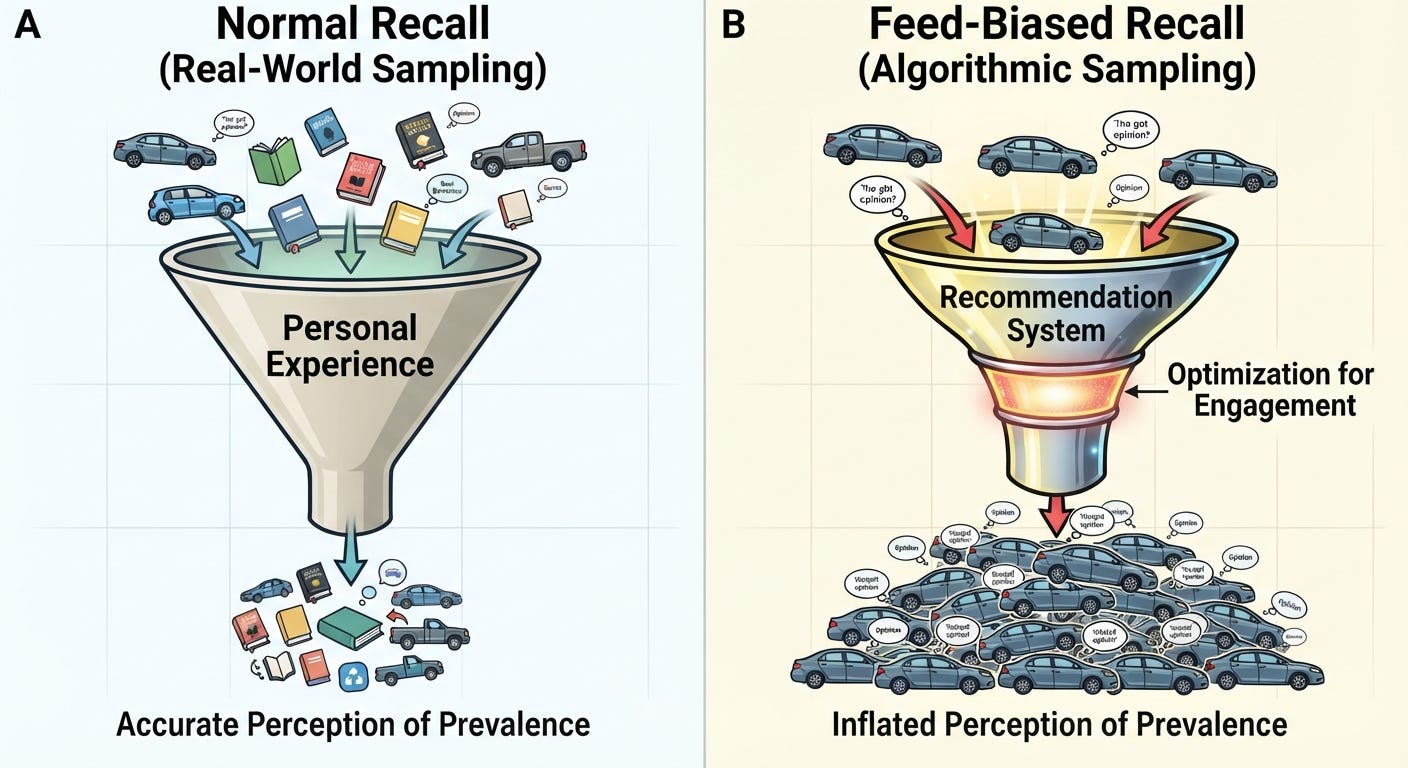
Here’s the useful part. Nothing is wrong with your brain.
In 1973, psychologists Amos Tversky and Daniel Kahneman described the availability heuristic, a mental shortcut where people judge how frequent or likely something is based on how easily examples come to mind. A memory that’s easy to retrieve gets treated as evidence about the world.
Under normal conditions, this shortcut works fine. If you can easily recall five friends who own a certain car, that car probably is common in your circle. The heuristic becomes less reliable when the examples you recall weren’t sampled from the world. They were sampled by a system with a different goal in mind.
Repetition does something else too. Research on the illusory truth effect has found that statements repeated more than once often get rated as more true, even though the repetition itself adds no new evidence. Your feed gives repetition a new delivery system.
Familiarity feels like prevalence. The two are not the same thing, and the feed has no incentive to remind you of the difference.
Your Feed Is Personalized
Television once gave large audiences a shared, if imperfect, selection of what mattered. Everyone watching the evening news saw roughly the same stories.
Behind your feed sits a recommendation system, software that uses algorithms to decide which pieces of content earn more visibility in front of you specifically.
Your feed is built from signals such as clicks, watch time, follows, and how long you linger before scrolling past. Two people searching the same topic can end up looking at entirely different information.
A 2025 study by Giwon Bahg, Vladimir Sloutsky, and Brandon Turner found more selective information sampling, inaccurate generalization, and inflated confidence in a controlled personalization experiment. Read the study on algorithmic personalization for the underlying research.
The study used a controlled experiment, not a social platform, so treat it as evidence of a mechanism rather than proof that every feed behaves identically. The mechanism matters. Your feed is not a representative sample of what’s out there. It’s a personalized information environment.
When Ranking Becomes a Governance Problem
Once you see that your feed is personalized, a second question follows. Personalized toward what?
Many social platforms build their recommendation systems around goals such as engagement, retention, time spent, and revenue. Those goals shape what the system rewards with more exposure.
A system built to hold attention doesn’t automatically optimize for accuracy. It doesn’t automatically optimize for representativeness, importance, or truth. Those are different goals, and nothing guarantees they line up.
This is where the AI governance question quietly shows up. Automated ranking should not become automated judgment. A system can decide what gets exposure. It cannot decide what deserves significance. That decision has to stay with a human.
Gen X skepticism has its own history here. Gen X didn’t become cynical. They became more accustomed to questioning institutions and messages before accepting them.
Visibility Is Not Prevalence
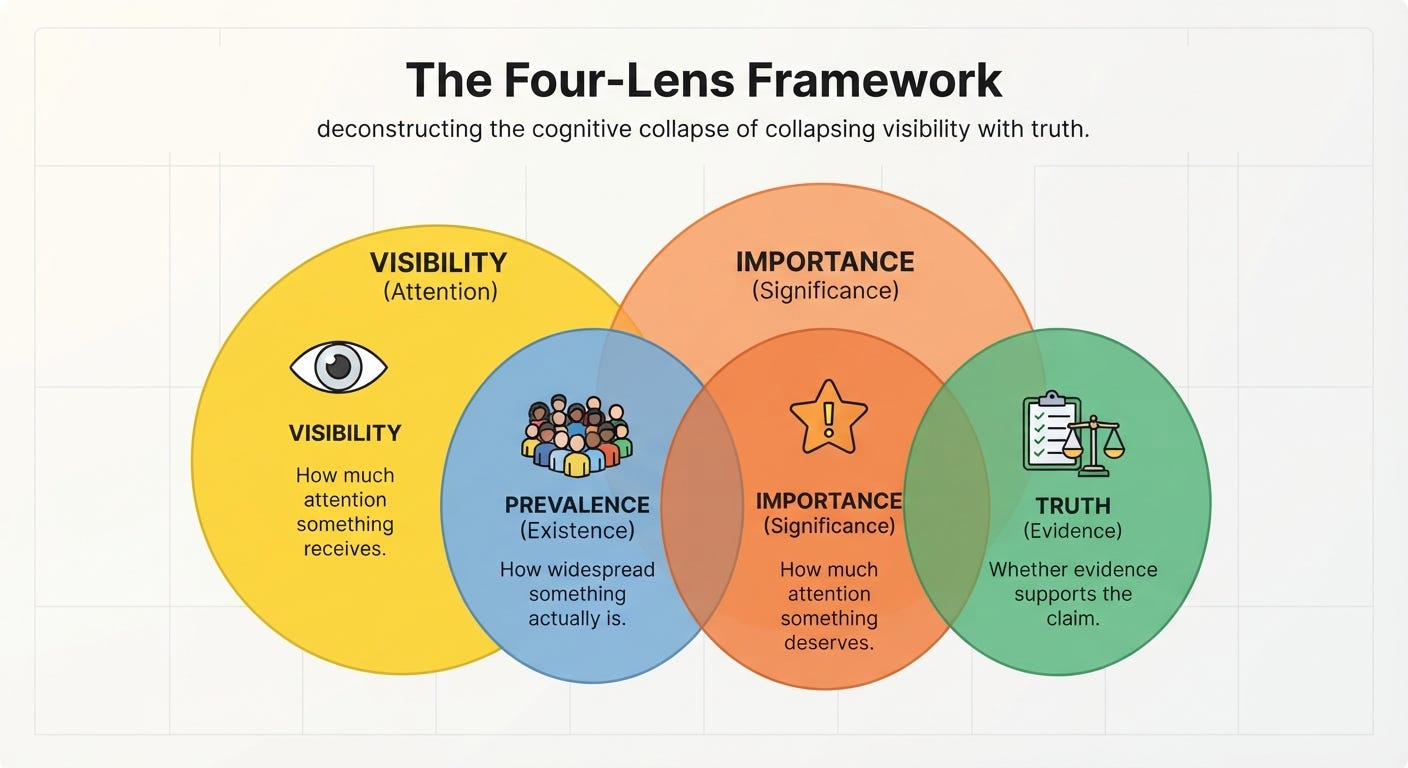
This is the idea the rest of the article rests on, so it deserves its own space.
Visibility is how much attention something receives.
Prevalence is how widespread something actually is.
Importance is how much attention something deserves.
Truth is whether the evidence actually supports the claim.
Picture a platform with ten million users. A post gets five hundred thousand views. That’s five percent of the platform. The numbers are illustrations, not a real platform’s statistics. Five hundred thousand views tells you something about reach. It tells you nothing about how many people believe what’s in the post.
Those are different measurements.
“Everyone is talking about it” quietly becomes “everyone believes it.” “Everyone believes it” becomes “this must matter.” “This must matter” starts to feel, without any evidence changing hands, like “this must be true.”
Visibility is not prevalence.
Once you can see that sentence clearly, you start noticing how often the four questions get flattened into one feeling.
Why Viral Doesn’t Mean Common
You see a political opinion repeated across your feed and assume most people hold it.
You see a health claim shared by five accounts and assume it’s evidence-based.
You see an unusual workplace story again and again and start to wonder if it’s becoming normal.
Viral reach measures attention. It does not measure prevalence, truth, or how representative the people sharing it actually are.
A post can spread through a small, tightly connected group and, from within the feed, look like a wave sweeping the whole population. The wave might be real. It might be six people and a lot of reposts.
What the Recommendation System Doesn’t Tell You
A feed tells you what the system selected. It does not tell you how common the underlying thing is, how representative the people posting about it are, where the original claim came from, or what independent evidence says.
Exposure measures what people saw. Prevalence measures how widespread something actually is. Engagement measures how people reacted to it. None of those measurements automatically tells you what people believe. They’re different measurements.
It also doesn’t tell you what got left out. Every ranking system includes some information and excludes the rest from your attention. That doesn’t mean everything excluded matters equally. It means the picture you’re building was never the whole picture, and the feed has no way of flagging its own gaps.
What you don’t see shapes your sense of reality as much as what you do.
How to Tell Whether Something Is Actually Common
Views are not votes. A view means someone encountered something. A share means someone passed it along. Neither one tells you what that person believes.
You don’t need a research degree. You need a habit. Before accepting that something you keep seeing is genuinely widespread, ask:
What is the source?
What population does the claim actually describe?
What’s the denominator? Common compared to what?
Are the sources genuinely independent, or all repeating each other?
What exists outside my feed?
Ask these questions before you share. The certainty often gets smaller once you know what the numbers actually measure.
The Visibility Pause
The Visibility Pause is a simple habit for evaluating highly visible information before you believe it, share it, or react to it.
It separates six things people often collapse into one feeling: why something is visible, whether it’s common or exceptional, whether it’s important or merely engaging, where the claim came from, what the feed leaves out, and what evidence would actually change your mind.
VISIBILITY PAUSE
Before you react:
Why am I seeing this?
Is this common or exceptional?
Is this important or merely engaging?
Where did the claim originate?
What exists outside my feed?
What would change my mind?
This isn’t about outsmarting a recommendation system. It’s a small mental shift, and the whole shift lives in one sentence.
Replace “this feels common” with “how common is this?”
That shift keeps the final judgment where it belongs. With you.
The Bigger Question
AI governance isn’t only about what automated systems decide on their own. It’s also about how those systems shape the information environment people use to make their own decisions.
Recommendation systems don’t determine what you believe. But algorithmic ranking does influence what you get the opportunity to notice in the first place. That distinction matters.
Somewhere out there, right now, someone is looking at something they’ve seen five times today, feeling certain it’s everywhere.
Their feed keeps supplying more. So does yours.
Your feed tells you what got attention. It doesn’t tell you what deserves yours.
Gregory Bourne is a writer, strategist, and AI consultant exploring technology, culture, work, and human judgment.