
Why The Onion Is Taking Over Infowars and What It Means for Accountability
A satire company is moving to take control of Infowars, the platform built on false claims about the Sandy Hook Elementary School shooting. This is not a media stunt. This is what happens when a court

AI-Generated Image
Episode #108
For more than a decade, Infowars operated as one of the internet’s most influential conspiracy platforms - not because it was credible, but because it was relentless. Now, after a series of legal judgments, a bankruptcy process, and more than eighteen months of court proceedings, that platform is on the verge of being handed to a satirical news outlet. The mechanics of how that happened are not complicated. The implications of what it means are.
If a platform caused documented harm, what does it mean to turn it into a product again?
What Is the Onion–Infowars Deal?
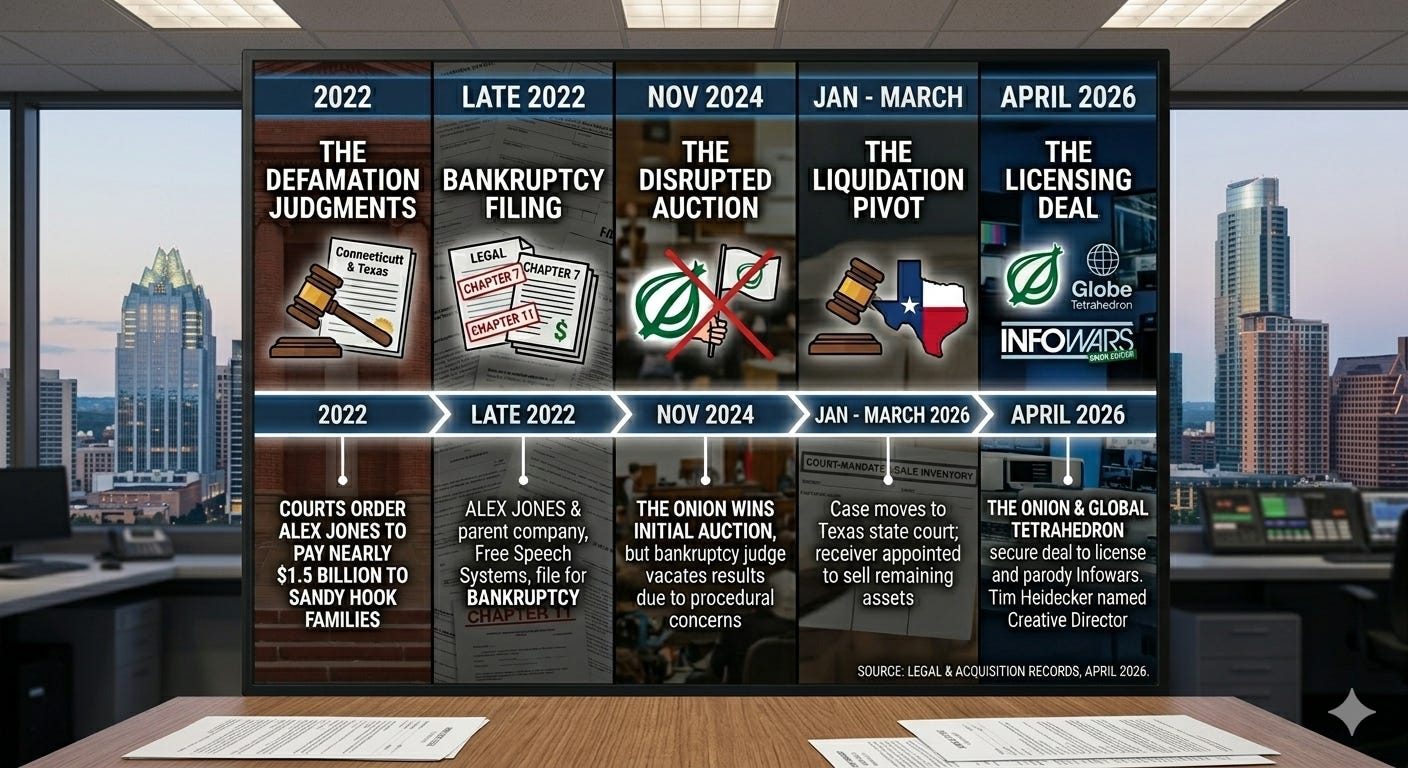
Infowars entered a bankruptcy process after courts ordered Alex Jones to pay over $1.4 billion in defamation judgments connected to the 2012 Sandy Hook Elementary School shooting
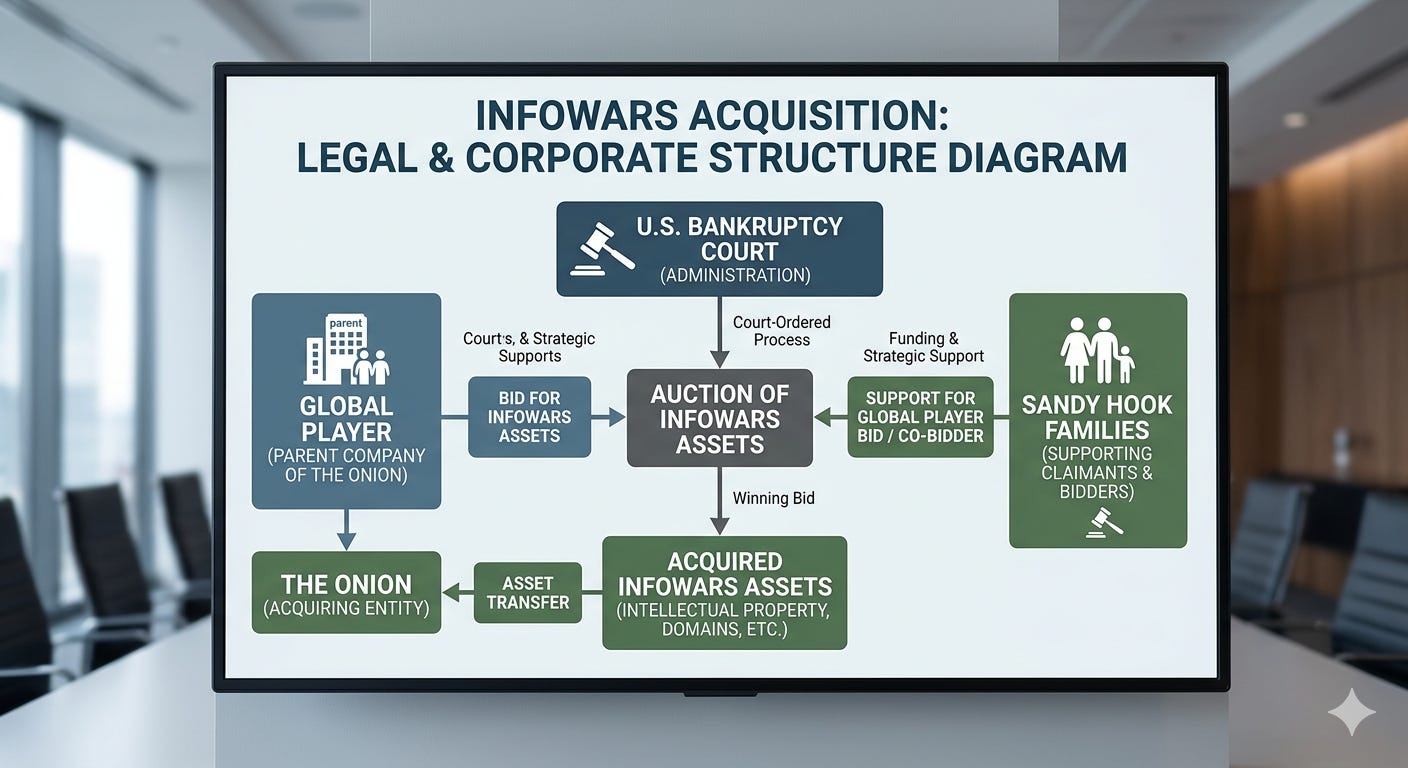
The assets of Infowars’ parent company, Free Speech Systems LLC, were placed under the control of a court-appointed receiver
The Onion, through its parent company Global Tetrahedron LLC, has reached a licensing agreement with the receiver to take control of the Infowars domain and intellectual property
Under the agreement, Global Tetrahedron would pay $81,000 per month to license the infowars.com domain and associated trademarks - a six-month deal with an option to renew
Proceeds from the arrangement flow through the receivership and connect to creditor claims, including those of the Sandy Hook families
The deal still requires approval from a Texas judge before it takes effect
What Happened to Infowars
Alex Jones launched Infowars in 1999. Over the following two decades, he built it into a significant far-right media operation with a large online audience, radio presence, and a supplement business that generated substantial revenue.
The turning point came with the Sandy Hook Elementary School shooting in December 2012. The attack killed 20 children and six adults, according to KUT Radio. In the years that followed, Jones used Infowars to claim the shooting was staged repeatedly. He falsely claimed that the shooting was a hoax and that the parents were crisis actors, Block Club Chicago. This was not an offhand comment. It was a sustained editorial position that his platform broadcast to millions.
The families of victims sued Jones for defamation in both Texas and Connecticut. The families won judgments in 2022 against Jones totaling $1.4 billion. Variety. The Supreme Court later rejected his appeal.
The financial exposure was not survivable. Jones filed for bankruptcy protection in 2022 after courts ordered him to pay $1.5 billion for defaming the families of 20 students and six staff members killed in the mass shooting. brecorder Unable to cover those judgments, his assets — including the Infowars brand - were pulled into the bankruptcy process.
How Infowars Became a Bankruptcy Asset
AI-Generated Image
Bankruptcy does not make a company disappear. It restructures the relationship between what a company owns and what it owes. When debts exceed assets, and the company cannot continue operating, a court intervenes to manage an orderly liquidation or reorganization. The goal is to recover as much value as possible for creditors - in this case, primarily the Sandy Hook families.
What that process exposed is something counterintuitive: Infowars still had value after its reputational collapse. Not because anyone trusted it, but because it had built something -a domain name with enormous search traffic, a recognizable brand, an established audience, and media infrastructure that had been developed over twenty-five years.
Jones has maintained control over the Infowars platform for about 25 years. Block Club Chicago. That history translates into digital equity: inbound links, search engine authority, and an audience that knows where to go. The name Infowars, regardless of what it came to represent, held commercial and structural value that the court could extract.
In August 2025, the state court ruled that Infowars’ parent company would be turned over to the court-appointed receiver, who would be responsible for selling the assets and using the proceeds to pay Jones’ debts to the Sandy Hook families. Bloomberg Law: The brand did not disappear with Jones. It became inventory.
Why The Onion Wants Infowars
The Onion’s interest in Infowars is not random. It is strategic in a way that the company has been relatively direct about.
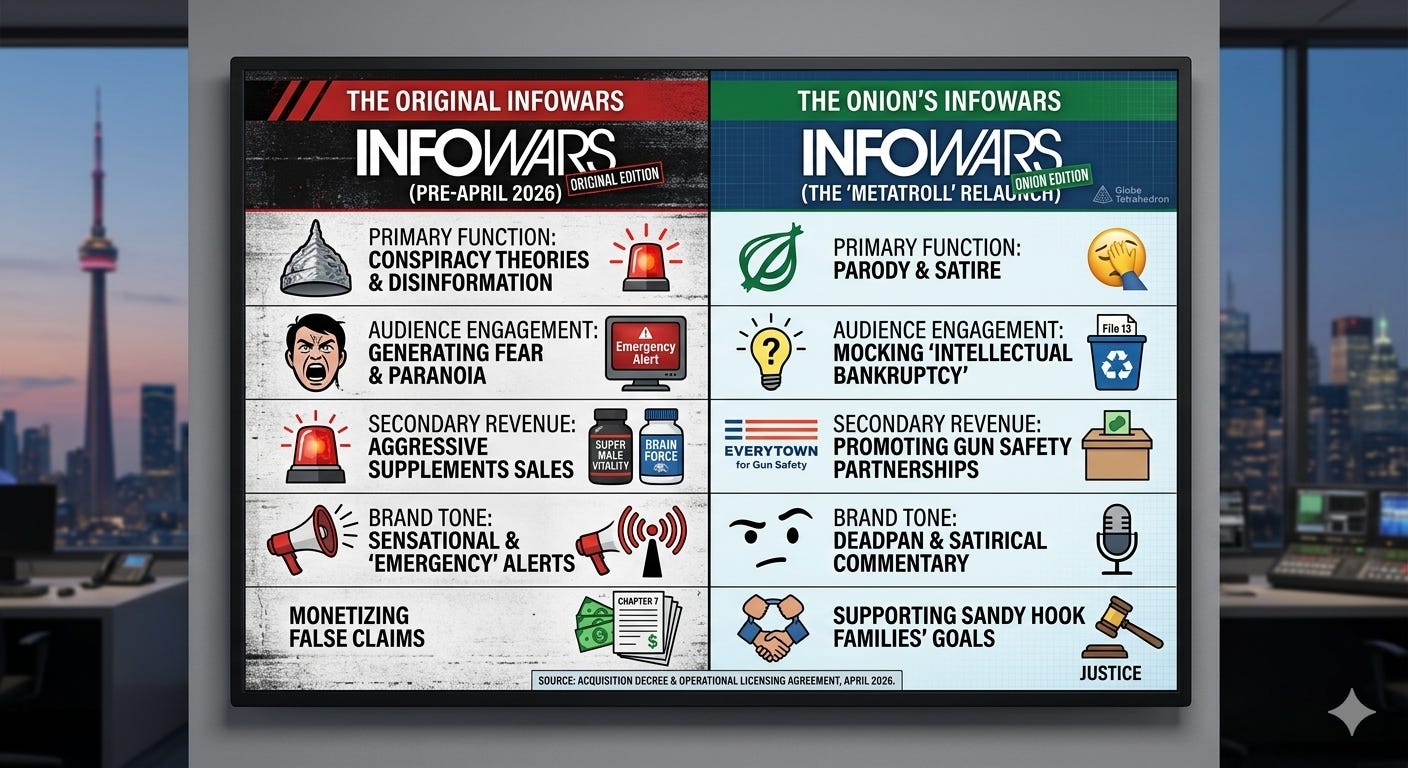
The Onion and its parent company, Global Tetrahedron, aim to turn Infowars into a parody of far-right conspiracy websites like the one Jones has operated since 1999. Variety The logic is structural, not comedic. If you control the domain, you control what users find when they type infowars.com into a browser. The audience that built habits around that address - a large, loyal, and ideologically committed group - would arrive at something entirely different from what they expected.
The Onion set up its own Infowars webpage, complete with a mock Infowars logo, and announced comedian Tim Heidecker as creative director of the new site. Courthouse News Service The parody is not subtle. The Onion has described the effort as designed to create a home for emerging and established comedic voices while expanding its role as a modern satire institution. Variety
The brand inversion is the point. Infowars’ value was always tied to trust — the belief, among its audience, that it was telling them something the mainstream wouldn’t. The Onion is acquiring that trust infrastructure and redirecting it. Whether the audience follows, resists, or simply leaves is a separate question from whether the takeover is structurally sound.
Onion CEO Ben Collins said, “You can’t just shut something like this down and pretend it never existed. If you want accountability to mean anything, you have to replace it with something better.” Bloomberg Law
What the Sandy Hook Families Stand to Gain
AI-Generated Image
The Sandy Hook families are not passive observers in this process. They are active participants who have backed The Onion’s efforts from the beginning.
The Connecticut families of eight victims of the school shooting backed The Onion’s bid, saying it would put an end to the misinformation machine that Jones operated. brecorder Their support is not only symbolic. The licensing payments The Onion makes flow through the receivership that exists specifically to recover funds owed to creditors, of which the Sandy Hook families are the primary group.
As of early 2026, it had been eight years since the Sandy Hook families initially filed suit, and they had not received any payments. CNN The legal judgments established what Jones owed. The bankruptcy process determines how much of that can actually be recovered. The Infowars brand, through The Onion’s licensing arrangement, is one of the mechanisms that converts judgment into cash.
The limits here are real and worth stating plainly. Financial restitution does not repair what these families experienced. The gap between what Jones was ordered to pay and what they are likely to collect is enormous. What the deal provides is a structured process -not justice in any complete sense, but a legal accounting of harm that produces some measurable outcome.
How Satire Becomes a Legal Strategy
This is where the story becomes something more than a media transaction.
Satire is no longer operating outside the system. It is operating inside it.
The Onion did not write a piece mocking Infowars from a distance. It entered a bankruptcy court, submitted a bid, negotiated a licensing agreement, and positioned itself as a creditor-aligned acquirer with court approval pending. That is not commentary. That is participation.
The families of those killed in the 2012 Sandy Hook Elementary School shooting, who sued Jones for defamation, want the sale to happen. NPR. Their support transformed what might have looked like a publicity move into a legitimate legal position. A satirical outlet became the preferred outcome of the people most harmed by the platform it is trying to acquire.
The sequence matters: Jones built a platform on false claims. Those claims produced real harm. That harm produced legal judgments. Those judgments produced a bankruptcy. That bankruptcy produced an asset auction. That auction is producing a new owner - a company whose explicit purpose is to invert everything the original stood for.
Satire entered at the end of a legal chain, not the beginning. It is the vehicle through which the court’s conclusions are implemented in the real world.
The tension this creates is worth holding: if satire enters the legal system as a strategy, does it still function as critique? The Onion operating inside a bankruptcy court is not the same as The Onion operating outside one. The tool changes when it becomes part of the machinery it was built to comment on.
Can Parody Repair Public Harm
The honest answer is: not entirely. And that is probably the right answer.
There is a difference between symbolic accountability and material accountability. Symbolic accountability is the message sent - a platform built on lies taken over by a satirical outlet, its audience confronted with the inversion of what they came for. That message is real. It communicates something about consequences.
Material accountability is money recovered and distributed to people who were harmed. That process is slower, smaller, and incomplete. The Onion CEO Ben Collins said the company wanted the Sandy Hook families to “be able to get paid for real at some point with actual human dollars as part of this process.” CNN The phrasing acknowledges the gap: paid at some point, actual human dollars, as part of a process that is still ongoing.
What The Onion is attempting is not repair. It is a replacement - putting something in the space that Infowars occupied and letting that substitution do work that legal judgments alone cannot. Whether an audience built on distrust of mainstream institutions will accept a satirical rebrand as the successor to their preferred source is a genuinely open question.
Attention was always Infowars’ core asset. The question is whether The Onion can hold that attention long enough for it to mean something.
AI-Generated Image
Infowars and The Onion Deal FAQ
Did The Onion buy Infowars? Not yet in the conventional sense. The Onion won a bankruptcy auction bid for Infowars in November 2024, but a federal bankruptcy judge rejected that deal in December 2024. Variety: The current arrangement is a licensing agreement that still requires court approval.
Why is Infowars being sold? Jones filed for bankruptcy after courts ordered him to pay $1.5 billion for defaming the families of victims killed in the Sandy Hook Elementary School mass shooting. brecorder His assets, including Infowars, were made available to help satisfy those debts.
What happens to Infowars next? If the deal is approved, The Onion plans to launch a new digital platform and comedy network at Infowars.com, led by creative director Tim Heidecker, in a matter of weeks. Variety
How are Sandy Hook families involved? The families are the primary creditors in the bankruptcy case. They have backed The Onion’s acquisition efforts, and the licensing payments The Onion makes will flow through the receivership that exists to recover money owed to them.
Who owns Infowars now? Free Speech Systems LLC, the Infowars parent company, is currently under the control of a court-appointed receiver, Bloomberg Law, while the licensing agreement with The Onion awaits judicial approval.
This is not a business story. It is a systems story.
Media ownership has shifted from being a question of influence to being a question of consequence. Platforms that caused harm are now being processed through legal systems that treat them as assets - things with value that can be sold, repurposed, and redirected. The audience, the brand, the domain authority: all of it survives the original operator, and all of it can be claimed by someone else.
A platform built on harm is now part of a legal process trying to account for that harm. The question is not whether the move is clever. The question is whether it works - whether the families receive what they are owed, whether the audience encounters something worth their time, and whether accountability in the digital age can mean something more than a number in a court filing.
That question does not have a clean answer yet. The deal has not been approved. The money has not moved. The platform has not relaunched.
What exists right now is a structure - one built not by journalists or satirists, but by a decade of legal process that finally produced an outcome someone could act on.
Sources: CNN, NPR, Bloomberg Law, Variety, Courthouse News Service, Block Club Chicago, KUT Radio
Thanks for Reading
Buy Me A Coffee |Gumroad| Medium
Gregory H. Bourne has spent years translating AI from Silicon Valley mythology into practical systems for people the tech world wasn't talking to. A published author of fiction and nonfiction and a working AI consultant, he writes specifically for Black solopreneurs and midlife founders - the ones who were told this revolution belongs to someone younger.